
Updated September 2026.
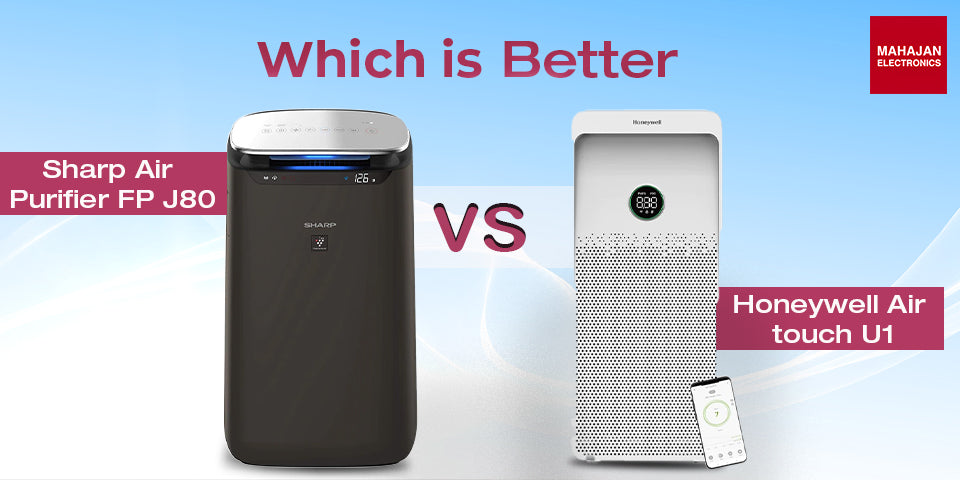
These two names come into the showroom together more often than any other pair. Somebody's done their reading, narrowed it to the Sharp FP J80 and the Honeywell Air Touch U1, and now they're stuck, because every page they've opened says both are excellent. They usually have the phone out with both tabs still loaded.
So here's the version we give across the counter, with the manufacturers' own published numbers instead of adjectives. We'll tell you where each one really wins, and we'll tell you the one thing about this comparison that almost nobody mentions, which is that on the measure most people assume separates them, these two machines are identical.
Sharp FP J80 vs Honeywell Air Touch U1: which should you buy?
Buy the Honeywell if your room is large, and buy the Sharp if your room is normal sized and someone sleeps in it. The Honeywell moves considerably more air an hour. The Sharp filters finer, runs much quieter on its low setting, and goes roughly twice as long between filter changes. Neither of those is a small thing, and which one matters depends entirely on the room you're buying for.
That's the short answer. Before the table, here's the question behind the question, because it comes up almost every time. People ask us which machine is better when what they mean is which machine is better for them, and those have different answers. We've watched customers buy the bigger unit out of caution and then never take it off the lowest setting, and we've watched people squeeze a small machine into a hall it was never meant for and blame the brand in February. A Sharp vs Honeywell air purifier choice is easy to get right and easy to get wrong for exactly the same reason, which is that it depends on one measurement almost nobody brings with them.
Here are both machines side by side, every figure taken from what the manufacturer publishes rather than from a marketplace listing.
| Sharp FP-J80M-H | Honeywell Air Touch U1 | |
|---|---|---|
| Clean air an hour | 480 m³/h on max | 700 m³/h CADR |
| Coverage on the box | 680 sq ft | 1085 sq ft |
| Room size by the AHAM rule | about 424 sq ft | about 618 sq ft |
| HEPA grade | H14 | H13 |
| Noise, low speed | 15 dB | 23 dB/A |
| Noise, max speed | 47 dB | not published |
| Rated power | 48 W on max | 70 W |
| Clean air per watt | 10.0 m³/h | 10.0 m³/h |
| Filter interval | up to 2 years | up to 9,000 hours or 1 year |
Figures as published by Sharp India and Honeywell. Clean air per watt is their own numbers divided, nothing added by us.
Which one actually cleans a room faster?
The Honeywell, by about 46%, and that's the single biggest difference between them. It's rated at 700 m³/h against the Sharp's 480 on maximum. In a room both machines are honestly sized for, the Honeywell gets there sooner and then holds the level with less effort.
One honest caveat, because we'd rather you heard it from us. Honeywell publishes a single figure and calls it CADR, which is the tested clean air delivery rate. Sharp publishes three figures for max, medium and low under a combined air flow and CADR heading. Those aren't quite the same thing. Air flow is how much air the fan pushes, CADR is how much of that comes out actually clean. If Sharp's 480 is a fan figure rather than a tested CADR, the true gap is wider than 46%, not narrower. Either way the Honeywell is the bigger machine.
What that means in a flat is simple. If you're buying for a drawing room that opens into a dining space, the extra air an hour is worth more than anything else on the spec sheet. If you're buying for a 12 by 14 bedroom, you'll never use it.
Is the Sharp's H14 filter better than the Honeywell's H13?
On paper it's ten times better, and in your flat you will not be able to tell. Both claims are true at the same time, and this is where most Sharp vs Honeywell air purifier comparisons go wrong.
The grades come from EN 1822, the European standard for high efficiency filters. H13 has to catch at least 99.95% of particles at the most penetrating particle size, so at most 0.05% gets through. H14 has to catch at least 99.995%, so at most 0.005% gets through (MANN+HUMMEL, EN 1822 classification). That's a tenfold cut in what escapes. The most penetrating particle size, the hardest size for any filter to catch, sits between about 0.1 and 0.2 microns (Camfil).
Now the part that puts it in perspective. A grade describes the filter media, not the machine. It tells you what happens to air that passes through the filter. It says nothing about how much of your room's air gets there in an hour, and that's CADR's job. A 99.95% filter with more air going through it cleans a big room faster than a 99.995% filter with less. In a sealed laboratory the H14 wins. In a Delhi flat with a door that opens, the machine that turns the room over more times wins.
Worth knowing too: Sharp's own listing for this model advertises it as trapping 99.97% of particles down to 0.3 microns, which is the older American way of stating HEPA performance and reads as a weaker claim than the H14 grade it also carries (Sharp Appliances India). Both statements are on the same page. We mention it because customers spot it and assume somebody's exaggerating, and nobody is. They're two different tests.
What size room does each one really cover?
About 424 sq ft for the Sharp and about 618 for the Honeywell, not the 680 and 1085 printed on the cartons. This is the number we spend most of our time on at the counter, and it's the one that decides whether you're happy in January.
The sizing rule comes from AHAM, the American Home Appliance Manufacturers association, which tests and certifies CADR. Their guidance is to pick an air cleaner with a smoke CADR at least two thirds of the room's area in square feet (AHAM). Their CADR is in CFM and India quotes m³/h, so convert once and the rule becomes: multiply your room's square feet by 1.13 and that's the minimum CADR you want. Run it backwards and 480 m³/h properly covers about 424 sq ft, while 700 m³/h properly covers about 618.
Both boxes overstate by a similar margin, so this isn't one brand being cheeky. It's the whole category. Go and measure the room before you choose, because the cheapest mistake in this aisle is the one you make with a tape measure and the dearest one is the machine you buy without it. We've laid the same arithmetic out room by room in our guide to the best air purifiers for Delhi pollution, and it's worth ten minutes before you spend anything.
Which is quieter when you're trying to sleep?
The Sharp, and on the low setting it isn't close. Sharp publishes 15 dB at low, 45 at medium and 47 on max. Honeywell publishes 23 dB/A at low speed and doesn't publish a figure for its higher speeds.
Eight decibels sounds like nothing written down. Decibels are logarithmic, so it isn't nothing. In a quiet bedroom at two in the morning, 15 dB is below the level most people register at all and 23 is a soft presence you'd notice if you were already awake. Take the comparison as indicative rather than exact, because manufacturers don't all measure from the same distance.
The old version of this page told readers the Honeywell was the quieter of the two. We've corrected that, because the published figures say the opposite, and we'd rather fix it than leave it standing.
Here's the practical bit though. Nobody runs a purifier on maximum all night. You run it hard for half an hour when you come home and shut the windows, then it drops to low or to auto and stays there. So low speed noise is the number that matters for a bedroom, and max speed noise is the number that matters for a drawing room where the television's on anyway.
Which costs more to run through a Delhi winter?
The Honeywell, by roughly Rs 200 a season on electricity, and the Sharp wins the filter side by a wider margin. Neither number is frightening, and both are smaller than people expect.
Take eight hours a day across the bad half of the year, which is about 1,450 hours. The Sharp at 48 W draws around 70 units. The Honeywell at 70 W draws around 101 units. At Rs 6.50 a unit, the 401 to 800 domestic slab in the Delhi domestic tariff schedule published by BSES, that's roughly Rs 450 against roughly Rs 660. A season of clean air for less than most people spend on one dinner out.
Now the number nobody works out. Divide clean air by watts and both machines deliver exactly 10.0 m³/h per watt. Identical. The Honeywell doesn't cost more to run because it's less efficient, it costs more to run because it's a bigger machine doing more work. We find that settles the argument for most people, because it means you're not paying a penalty for choosing either one. You're just choosing a size.
People are usually relieved by that. The worry we hear most often is that running a purifier all winter will do something dramatic to the bill, and it won't. What it will do is quietly add 13 to 30 units a month, and if that tips you into the next tariff band then everything else you ran that month gets dearer too. Worth knowing if you're already close to a boundary.
Filters are the other half, and here the Sharp pulls ahead. Sharp rates its filter set at up to two years. Honeywell rates the U1's at up to 9,000 hours or a year. Over five winters that's roughly half as many filter purchases on the Sharp, and filters are the cost that surprises people the following year, not the electricity. We've broken the whole picture down in our piece on what an air purifier actually costs to run.
Sharp or Honeywell: which brand suits which home?
Sharp is the engineering buy and Honeywell is the coverage buy. That's the fairest one line summary we can give you after years of selling both, and it holds up beyond just these two models.
Sharp builds in Japan, puts Plasmacluster ion output alongside the filter, grades its HEPA at H14 on the larger models, and tunes the machines to be very quiet. You pay for that, and the range is smaller. The people who come back happiest with a Sharp are the ones who care about the bedroom being silent and who liked the idea that the filter lasts two years.
Honeywell gives you more air for the money, a much wider range of models at every price, an app, and UV LED on the upper models. The people who come back happiest with a Honeywell are the ones who bought for a big open living area and wanted the room turned over quickly.
The question we actually get asked in the shop is rarely about these two model numbers. It's the brand level version: is Sharp or Honeywell better. The honest answer is that a Sharp vs Honeywell air purifier decision is a question about your room, not about the badge. Measure first, then pick the badge you like.
Which air purifier do we hand people at the counter?
One of these three, depending on the room, and we'll say which for each. Every one of them is a machine we're happy to stand behind after it leaves the shop.
Sharp FP-J80M-H Air Purifier
The one this whole page is about, in the high Rs twenties. 480 m³/h through H14 HEPA and carbon behind a washable PM10 pre filter, 15 dB at low, 48 W at full tilt, filter interval up to two years. Buy it for a bedroom or a normal sized living room up to about 424 sq ft. It's the machine we suggest when somebody says the words light sleeper, and the two year filter is the part they thank us for later.
Honeywell Air Touch U2 Air Purifier
The U series machine in the current Honeywell range, also in the high Rs twenties. Honeywell publishes 650 m³/h CADR, 1008 sq ft of claimed coverage, a seven stage filtration stack with H13 HEPA, UV LED and an ionizer, 38 dB/A at low and a 9,000 hour filter interval. By the AHAM rule that's about 574 sq ft covered properly. If you came here for the U1 and want the big room answer from Honeywell, this is the model to look at. Note the 38 dB at low, which is louder than the U1 was, so it's a living room machine rather than a bedside one.
Honeywell Air Touch P2 Air Purifier
Our value pick of the three, in the high Rs teens. Honeywell publishes 550 m³/h CADR, 853 sq ft claimed, four stage filtration with H13 HEPA, 50 W and 23 dB/A at low. That's about 486 sq ft covered properly, more air than the Sharp for noticeably less money, and it's quiet enough for a bedroom. This is the one most people walk out with when they arrive undecided and we've talked through the room with them.
Where can I buy a Sharp or Honeywell air purifier in Delhi NCR?
You can buy either brand online from us and have it delivered across Delhi NCR, or come and stand next to them running. Our full range sits in the air purifier collection, and if you've already settled on one badge you can go straight to the Honeywell range.
Our honest advice, and it costs us nothing to give it: come in with the dimensions of the room written down. Length, width, and whether it opens into another space. Two minutes with that and we can tell you which of these machines is right and, just as often, that a smaller one will do you fine. We've talked plenty of people down to a cheaper purifier than the one they walked in asking for, because a machine sized for the room you actually have beats a bigger badge every winter.
And if you take nothing else from this Sharp vs Honeywell air purifier comparison, take this: in a Sharp vs Honeywell air purifier decision the two machines are equally efficient with your electricity, the filter grades are closer in practice than they look on paper, and the only question that changes your answer is how big the room is.