
Updated September 2026.
Every October, the same question comes into the showroom: does an air purifier actually do anything once the smog rolls in, or is it just a fan with a filter and a marketing budget? It's a fair question. Delhi's winter runs from the last week of October to about the end of January, and an air purifier for winter smog is the one appliance in the house you're relying on for months, not days. So we looked at the actual trial data instead of repeating the usual five bullet points, and we're going to give you the honest version, caveats included.
Does an air purifier actually work against winter smog?
Yes, but the honest number is a meaningful cut, not a miracle. A randomised controlled trial run in Ulaanbaatar, Mongolia, a city whose winter coal-heating smog rivals Delhi's for severity, found that homes running portable HEPA air cleaners had indoor PM2.5 levels 29% lower than homes without one, with a 95% confidence range of 21 to 37% (UGAAR trial, published in Environment International). Outdoor PM2.5 in that study peaked at 118 µg/m³ in winter, in the same range as a moderately bad week in Delhi.
There's a catch worth knowing before you buy. The same trial found effectiveness was highest right after the air cleaner was set up, at 40%, and dropped to 15% after about five months of use. That drop isn't the machine wearing out, it's what happens when a pre-filter loads up with dust and nobody rinses it. A purifier you install in October and never touch again is doing roughly half the job by February.
Won't keeping the windows and doors shut do the same job for free?
No. A study conducted in New Delhi during peak winter found that opening or closing the windows barely changed indoor PM2.5 and PM10 levels at all (Singh, Mondal and Dewan, 2021). Outdoor smog gets in through door gaps, window frames and every time someone walks in from outside, closed windows or not. That's not an argument against shutting your windows, it's just evidence that shutting them isn't a substitute for actually filtering the air that's already inside. This is the part most winter guides skip, and it's the actual reason an air purifier earns its place in the room rather than a sealed door.
| Delhi winter season | Average PM2.5 |
|---|---|
| 2023-24 (Oct-Feb) | 171 µg/m³ |
| 2024-25 (Oct-Feb) | 159 µg/m³ |
Source: Centre for Research on Energy and Clean Air, Winter Ambient Air Quality Snapshot, based on CPCB monitoring data. Both winters put Delhi at or near the top of the national list, roughly thirty times the WHO annual guideline of 5 µg/m³.
Read that pattern as what it is: a recurring winter, not a one-off bad year. It's why this is a seasonal appliance decision, not a one-time emergency purchase.
Why does indoor air get worse in winter even with the doors shut?
Because the things that normally leave through an open window in summer, dust, pet dander, cooking smoke, heater particulates, have nowhere to go. A handful of things stack up at once once the cold sets in:
- Less natural ventilation. Doors and windows stay shut to keep the warmth in, and the normal air exchange that clears dust and odours in summer mostly stops.
- Heaters and space heaters add their own particulates. Room heaters, especially older ones, throw off dust and ash from the element every time they're switched on for the season.
- Pets shed more and go outside less. Fur and dander that would normally settle outdoors builds up on carpets and furniture instead.
- Outdoor smog gets in anyway. As the study above shows, a shut window slows infiltration, it doesn't stop it.
None of these are individually dramatic. Together, in a sealed room for four months, they add up to indoor air that's often worse than what a summer window would ever let build up.
Does dry winter air make the smog problem worse?
It makes the symptoms worse, even though it's a separate problem from particulate smog. Winter heating and cold outdoor air both push indoor relative humidity down. Research reviewed by the US National Institutes of Health puts the ideal indoor range at 40 to 60% relative humidity for respiratory comfort, below which the mucous membranes lining your nose and throat dry out and stop filtering as well as they should (Indirect health effects of relative humidity in indoor environments, NIH). That's a real reason winter mornings feel worse even on an indoor-only day, and it's on top of, not instead of, the particulate load a HEPA filter deals with. A purifier doesn't add humidity to the room. If your home runs dry as well as dusty, that's a separate appliance, not a feature to expect from an air purifier.
How much does an air purifier actually cut my exposure over a Delhi winter?
Enough to matter, especially in the room you sleep in, provided the filter gets looked after. Based on the trial data above, expect somewhere in the range of a quarter to a third off indoor PM2.5 on average across the season, higher in the first couple of months on a fresh filter, lower by January if the pre-filter hasn't been rinsed. That's not the same as clean air. It's the difference between air that's bad and air that's noticeably less bad, every day, for four months, which is what actually moves the needle on sleep and breathing rather than a single dramatic before-and-after number.
Buying the right size purifier matters just as much as filter grade. We've worked through the full CADR maths, room by room, in our guide to the best HEPA air purifiers for Delhi pollution, and it's worth five minutes before you buy, because a purifier sized for a bigger room than yours is doing less work than the box suggests.
Which air purifier for winter smog should I buy?
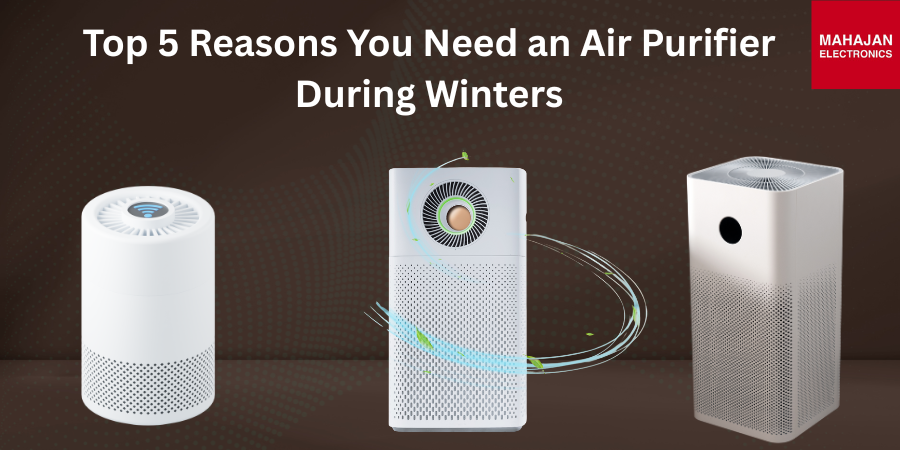
Two of our most reliable picks for the season, sized differently, both verified H13 HEPA.
Honeywell Air Touch V3, under Rs 10,000
Our most sold bedroom purifier going into winter. A 300 m³/h CADR through H13 HEPA and carbon stages gives real coverage well past a standard bedroom, with enough headroom for a severe week without running flat out all night.
Honeywell Air Touch P1, mid Rs teens
The drawing room answer for most flats, at 450 m³/h CADR. A living room usually has a front door opening onto a corridor all evening, which is exactly the kind of repeated infiltration the window study above found closed doors don't stop, so it benefits from the extra CADR over a bedroom-sized machine.
Sharp DW-T30FM-W, low Rs 40,000s
For the specific case of a ground floor or basement room that runs damp through the season. This one pairs HEPA-class filtration with 30 litres a day of dehumidification, useful where the humidity problem is too much moisture rather than too little.
Do I need to run it all day, every day, through winter?
Not at full blast, but yes, more or less continuously in the rooms you actually use once the season turns bad. Run it overnight in the bedroom at minimum from the point the air outside turns consistently poor, and through the evening in whichever room the household spends time in. Clean the pre-filter monthly through the season. That single habit is the difference between the 40% and the 15% numbers in the trial above, and it costs nothing but five minutes with a tap and a soft brush.
What mistakes cut a winter air purifier's real effectiveness in half?
- Never rinsing the pre-filter. This is the single biggest reason the trial above found effectiveness fall from 40% to 15% over a season. Delhi dust loads a pre-filter within weeks, not months. Rinse it monthly through winter and the machine keeps doing its job.
- Buying on brand instead of room fit. A well known name sized for the wrong room does less than a lesser known one sized correctly. Match the CADR to the room, not the logo on the box.
- Running it only when the AQI app sends an alert. Indoor particulate matter builds up gradually through a sealed winter room. A purifier switched on for an hour after a bad reading is playing catch-up, not staying ahead of it.
- Assuming it fixes dry air too. As above, a HEPA purifier filters particles, it doesn't add moisture. If congestion and dry throat are the bigger complaint in your house, that calls for a humidifier alongside it, not instead of it.
Where can I buy an air purifier for winter smog online?
You can buy an air purifier online from us with delivery across Delhi NCR, or bring your room's dimensions into the showroom and we'll help you size it properly rather than sell you the biggest box on the shelf. We'd rather you buy the right machine for the room you're actually trying to protect than the one with the most impressive number printed on the front.