
Updated November 2026.
These two radiators get asked about as a pair more than almost any other in the heater aisle. Somebody's read that the Havells Hestio is the premium one and the Bajaj Vienna is the sensible one, they've seen that both have 13 fins and both say 2,900 W, and now they want us to tell them what the extra money buys.
So here's the Bajaj vs Havells oil heater comparison we give across the counter, built from what Bajaj and Havells publish about their own heaters rather than from marketplace listings. We'll tell you where each one wins. We'll also tell you the thing that surprises most people about this comparison, which is that inside the case these two heaters are close to the same machine, and the old version of this page got that badly wrong.
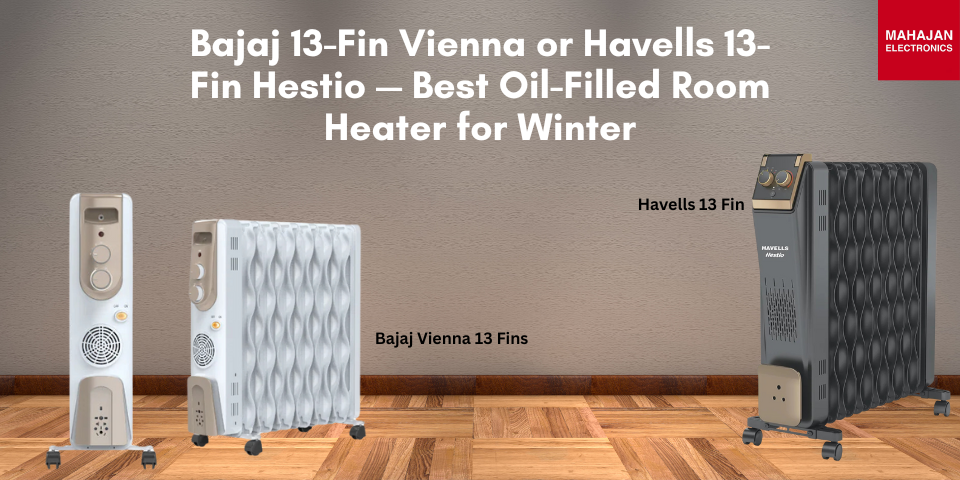
Bajaj Vienna 13 fin vs Havells Hestio 13 fin: which should you buy?
Buy the Bajaj Vienna if you want the most warranty and published safety for your money, and buy the Havells Hestio only if its wheels, control panel and cord storage are worth paying more for. They make the same heat. Both pair a 2,500 W oil-filled radiator with a 400 W PTC fan heater, both use wave shaped fins, and both carry a thermostat, a tilt or tip-over switch and a thermal cut-out. What separates them is the case, the warranty and the price.
That's the short answer, and it's the opposite of what most people walk in expecting. The question behind the question is usually this: is the Havells worth the extra? People ask us which heater is better when what they're asking is whether the dearer badge buys more warmth. It doesn't. A Bajaj vs Havells oil heater decision at 13 fins is a decision about how you'll live with the thing, how often you'll move it, where the cord goes, and what happens if a fin weeps oil in year four. It isn't a decision about heat.
Here they are side by side, every figure taken from the manufacturer's own product page.
| Bajaj Vienna 13 fin (260096) | Havells Hestio 13 Wave Fin (GHROFCLK290) | |
|---|---|---|
| Oil-filled element | 2,500 W | 2,500 W |
| PTC fan heater | 400 W | 400 W |
| Total rated power | 2,900 W | 2,900 W |
| Heat settings | 1,000, 1,500 and 2,500 W | not broken down by Havells |
| Fin design | wave fins | wave fins |
| Thermostat | adjustable | adjustable |
| Safety cut-offs | manual thermal cut-out, tilt switch, thermal fuse | tip-over switch, thermal cut-out (auto and manual), rear safety cover |
| Moving it | castor wheels and built-in handle | retractable wheels |
| Weight, packed | 13.6 kg | 13.5 kg |
| Cord and plug | 1.5 m PVC cord, 16 A plug, cord winder | cord winding station with plug socket |
| Warranty | 3 years on the product | 10 years on the fins |
| Our price band | just over Rs 10,000 | around Rs 12,000 |
Bajaj figures as published on the Bajaj Electricals Vienna OFR page, 13 fin variant. Havells figures as published on Havells's own product page for the GHROFCLK290. We haven't linked that page, because Havells's site refuses automated checks and we only link sources we can confirm a reader will be able to open. Search the model number on havells.com and you'll find the same list.
Do the Bajaj and the Havells put out different amounts of heat?
No. Both are a 2,500 W radiator with a 400 W fan heater on top, 2,900 W in all, so at full power they warm a room equally. If two heaters draw the same watts, they turn the same electricity into the same heat.
Where they differ is in how much they tell you about the steps in between. Bajaj publishes three heat settings on the radiator, at 1,000, 1,500 and 2,500 W, with the 400 W fan as an extra on top. Havells publishes the 2,500 W and 400 W split but doesn't list the individual steps on its product page, so we won't quote them.
Those steps matter more than the top figure. Nobody runs a 13 fin radiator flat out all evening. You'll bring the room up on full, then drop to the middle step and let the thermostat do the rest. That's where most of your winter is spent, so the lower settings are the ones you're really buying. If you want to know how much heat your particular room needs, our room heater size guide walks through it by room size, and it's the better place to start than either badge.
Does either heater have a fan heater built in?
Both do, a 400 W PTC fan heater each, and the old version of this page said only the Havells had one. We've corrected that, because Bajaj's own page lists a "400 PTC ceramic fan heater for faster heating" on the 13 fin Vienna, and we'd rather fix it than leave it standing.
That old claim did real damage to the comparison. It sold the Havells as the faster heater and the Bajaj as the slow, silent one, and the whole recommendation rested on it. On the manufacturers' own figures there's no such split. Both radiators can blow warm air in the first few minutes while the oil comes up to temperature, and both go quiet once you switch the fan off and leave the oil to it.
The practical bit: the fan is for the first ten minutes of a cold evening, not for the night. Once the room's warm, switch it off. It's the only part of either heater that makes a sound, and it's the part people forget is still running. If you're still weighing whether you want a fan heater at all, or a radiator, that's a different question, and we've answered it properly in our guide to electric heater vs oil-filled heater.
Is the Havells wave fin better than the Bajaj fin?
Not on anything either company publishes, because the 13 fin Vienna has wave fins too. Bajaj describes its fins as a wave design "for increased surface area and heat transfer". Havells calls its model the Hestio 13 Wave Fin.
A wave or curved fin has more metal surface than a flat one of the same size, so it can shed the same heat at a slightly lower surface temperature and spread it more evenly. That's a fair reason to prefer wave fins over flat ones. It isn't a reason to prefer one of these two over the other, since they both have them, and neither company publishes a figure that would let you compare one wave against the other.
Bajaj adds its DuraProtek name for anti-leak fins, and Havells adds a fin warranty, which is the more useful promise because you can claim on it. If you're comparing a 13 fin against an 11 fin of either brand, that's a different sum, and our size guide covers what the extra fins do and don't buy you.
Which has the better thermostat and safety cut-offs?
They're level on the things that matter most, an adjustable thermostat, a switch that cuts power if the heater tips, and a thermal cut-out for overheating. Each brand then adds one thing the other doesn't list.
Bajaj groups its protection as Quadra Safety: the thermostat, a manual thermal cut-out, a tilt switch and a thermal fuse. A fuse is a last line of defence. If everything else fails and the heater keeps getting hotter, the fuse breaks the circuit for good, and the heater needs a service before it works again. That's the outcome you want from a fault in a room with someone asleep in it.
Havells lists an adjustable thermostat, a tip-over switch, a thermal cut-out that works both automatically and manually, and a rear safety cover. The cover keeps fingers and fabric away from the back of the element housing, which is the hottest part of most radiators and the part a curtain tends to fall against.
So which is safer? On paper, it's a draw with different emphasis. Bajaj adds the fuse, Havells adds the cover. Both cover the two accidents we hear about most, a heater knocked over by a child or a dog, and a heater left on full in a closed room. Neither covers you if a towel is drying over it, and that's still the one we'd warn you about first.
Which one is easier to move around the house?
They weigh almost exactly the same, so it comes down to wheels and handle, and that's a matter of taste. Bajaj lists the Vienna at 13.6 kg packed and Havells lists the Hestio at 13.5 kg gross. A tenth of a kilo is nothing you'll feel.
One caveat, because we'd rather you heard it from us. Bajaj's page shows a single weight block, 11.6 kg net and 13.6 kg packed, that appears against both its 11 fin and 13 fin Vienna. The 13 fin has two more fins of steel and oil, so treat the Bajaj figures as a floor rather than an exact number for this model.
The Bajaj rolls on castor wheels and has a built-in handle, which is the plain arrangement most radiators use. The Havells has retractable wheels that fold in when you're not moving it, and Havells says that adds stability when it's standing. If the heater lives in one room all winter, the difference is close to zero. If it moves from the drawing room in the evening to the bedroom at night, wheels that roll well over a door threshold matter more than any spec, so push both across the floor before you choose.
What about the power cord, the plug and the socket?
Bajaj publishes a 1.5 m PVC cord with a 16 amp plug, and Havells publishes a cord winding station with a dock for the plug but not the cord length or plug rating. Either way, a 2,900 W radiator belongs on a proper 16 amp socket.
Run the sum and you'll see why. 2,900 W at 230 volts is about 12.6 amps, well past what a 6 amp socket and plug are built to carry. The Bajaj's 16 amp plug tells you that straight away. With the Havells, check the plug when it comes out of the box. A 1.5 m cord is short, so plan where the heater will stand before it arrives, because the answer can't be an extension board. Our size guide covers the socket question in more detail.
In a Bajaj vs Havells oil heater comparison, the cord storage is where the Havells earns some of its price. Its winding station has a socket for the plug to sit in, so the plug doesn't swing about or get stepped on when you wheel it away. Bajaj gives you a cord winder too, just without the plug dock.
Which one comes with the better warranty?
The Bajaj, on what each company publishes, because its three years cover the whole heater while the Havells figure we can confirm covers the fins. Those aren't the same promise, and it's worth being clear about which is which.
Bajaj lists a 3 year product warranty on the 13 fin Vienna, in both its highlights and its specifications. Havells advertises a 10 year fin warranty on the Hestio. That's a long time, and fins are the part that can't be repaired if they leak, so it's a good promise to have. But a fin warranty doesn't cover the thermostat, the switches, the fan or the element, and those are the parts that fail first in our experience. Havells's product page doesn't state a warranty for the rest of the heater, so ask for the card and read it before you pay.
Our view is simple. Three years on everything is worth more to most homes than ten years on the fins alone, because a dead switch in year two is a far likelier problem than a leaking fin in year eight. If you keep heaters a very long time, the Havells promise starts to look better. Either way, fill in the warranty card the day it arrives. Plenty of the warranty arguments we see could have been avoided by that.
Does the Bajaj or the Havells cost more to run?
Neither, and that's the easiest part of any Bajaj vs Havells oil heater question. Same watts means the same units on your meter, so at the same setting for the same hours they cost the same to run. Any difference you notice on the bill will come from the thermostat setting you choose, not from the brand.
If you want to work out what a 2,900 W radiator adds to a Delhi bill month by month, including how it can push the whole household into a dearer tariff slab, we've done that sum in our main guide to room heaters for home.
Bajaj or Havells: which brand suits which home?
Bajaj is the value buy and Havells is the design buy, at least in this pair of radiators. That's the fairest one line summary we can give you, and here it's a smaller gap than the price suggests.
The Bajaj gives you the same 2,900 W, the same wave fins and the same PTC fan for less money, with a longer whole-product warranty and a thermal fuse on top. The people who are happiest with a Vienna are the ones who wanted heat, safety and a warranty and didn't care what the case looked like.
The Havells gives you an inclined control panel that's easier to read without bending, wheels that tuck away, a dock for the plug, a rear safety cover and a long fin warranty. It looks better in a drawing room. The people who are happiest with a Hestio are the ones who see the heater every day and wanted it to look like furniture rather than an appliance.
So a Bajaj vs Havells oil heater choice comes down to which of those descriptions sounds like you. If you've been told the Havells heats faster, it doesn't, not on either company's published figures. If you've been told the Bajaj is the basic one with no fan, that's the old error we've corrected above.
Which oil heaters do we hand people at the counter?
The Bajaj Vienna 13 fin first, then one of these two depending on why you were looking at the Hestio. We'd have put the Hestio itself on this list, but it isn't one you can order from our website, and nor is any other Havells radiator, so there's no link on it here. We'd rather tell you that plainly than send you to a page you can't buy from.
Bajaj Vienna 13 Fin Oil Filled Radiator
The one this page comes down in favour of, just over Rs 10,000. Thirteen wave fins on a 2,500 W element with three settings at 1,000, 1,500 and 2,500 W, a 400 W PTC fan heater for the first few minutes, an adjustable thermostat, a manual thermal cut-out, a tilt switch and a thermal fuse, castors, a handle, a cord winder, a 1.5 m cord on a 16 amp plug and a 3 year product warranty. It's ISI marked. It's the one we suggest when somebody says they want the Havells's heat without the Havells's price, because on the published figures that's exactly what it is.
Philips CX3013 13 Fin Oil Filled Radiator
For the person who wanted the Hestio because it's the premium choice, under Rs 15,000. Philips publishes thirteen M shaped fins, which it says heat 30% faster than straight fins of the same size, five power settings from 400 to 2,900 W, a thermostat knob, overheat shut-off and a tilt switch that cuts power past 40 degrees, on castors with a two year warranty. That 400 W bottom step is the thing to like here, because it lets a big radiator tick over gently in a bedroom once the room's warm. It's the closest thing we sell to what the Hestio promises, a well finished 13 fin radiator from a brand people trust.
Bajaj Vienna 11 Fin Oil Filled Radiator
The same heater with two fewer fins, under Rs 10,000. Bajaj publishes the same 2,500 W element and 400 W PTC fan, the same 1,000, 1,500 and 2,500 W steps, wave fins, an adjustable thermostat, manual and automatic thermal cut-outs, a tilt switch, castors and a 1.5 m cord on a 16 amp plug. Same heat in, less oil to hold it after the thermostat clicks off. Bajaj's page lists both one year and three years for this version's warranty, so check the card in the box. For a normal bedroom it's plenty, and it's the one we point to when the budget's tight and the room isn't big.
Where can I buy a Bajaj or Havells oil heater in Delhi NCR?
You can buy the Bajaj Vienna and the other radiators above online from us, with delivery across Delhi NCR, or come into the showroom and see them side by side. The full range sits in our heaters collection, from small halogens to 15 fin radiators.
Our honest advice, and it costs us nothing to give it: before you spend anything, decide where the heater will stand and check that there's a 16 amp socket within a metre and a half of that spot. Then decide whether you'll be moving it between rooms. Those two answers settle most Bajaj vs Havells oil heater arguments faster than any spec sheet, because the heat is the same and the case is the difference.
And if you take one thing from this page, take this. At 13 fins, Bajaj and Havells sell you the same 2,900 W of warmth. Pay for the warranty, the safety features and the wheels you'll use, not for a promise of faster heat that neither company's own figures support.