


Description
Ten Years on the Compressor.
On the Part That Decides Everything.
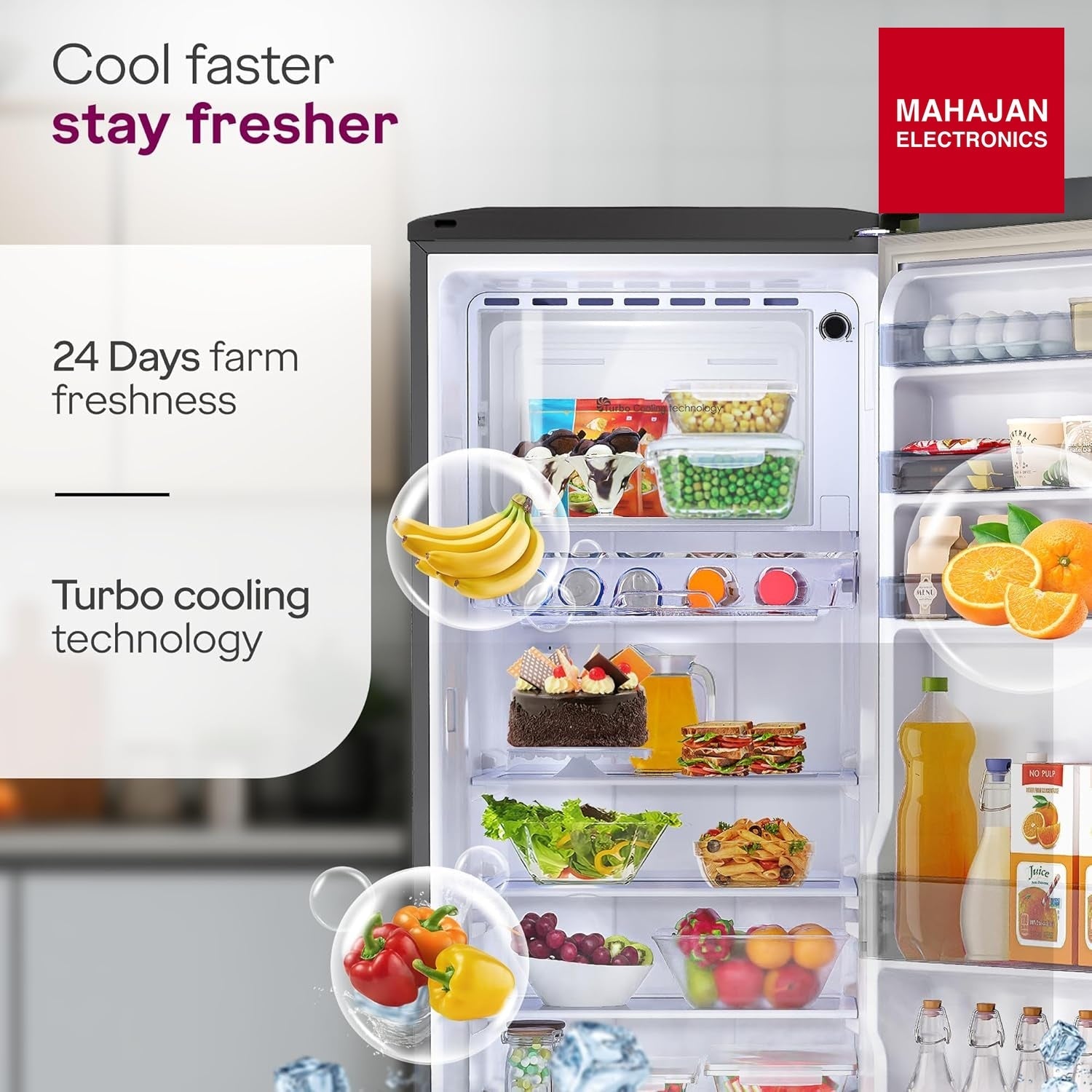
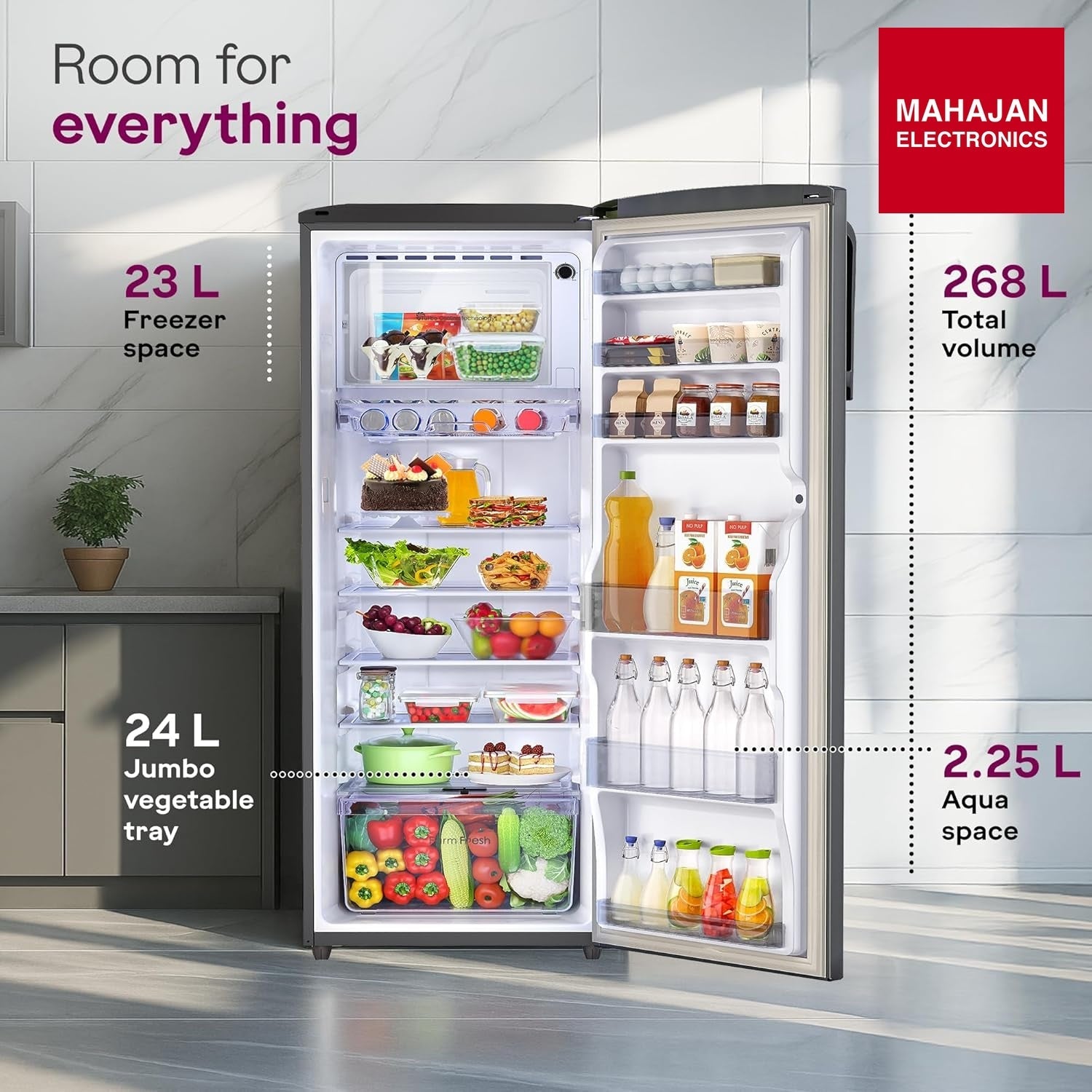
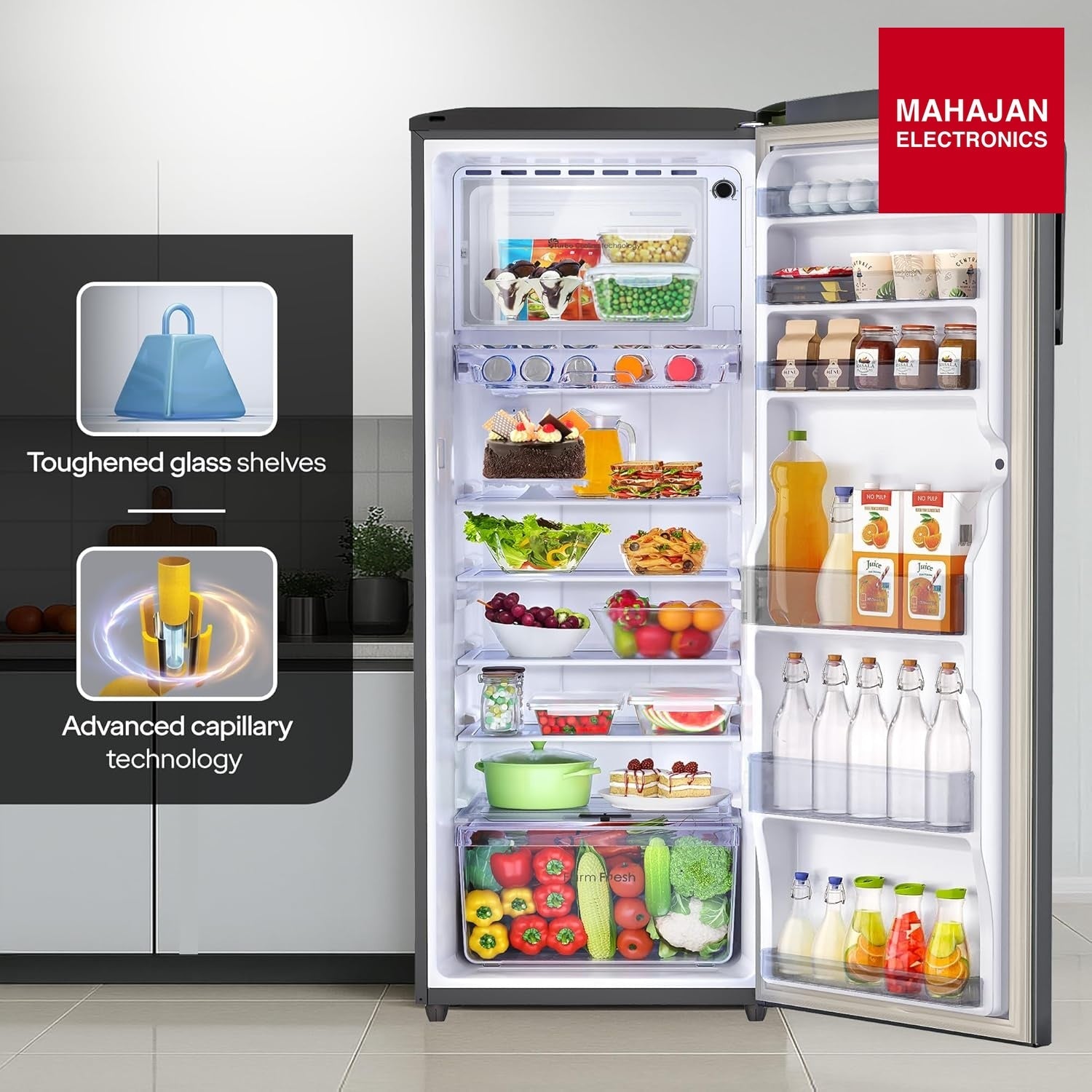
A 268 litre single-door fridge with the specification that matters most covered for a decade · an inverter compressor that varies its speed rather than switching on and off — quieter, steadier and more efficient · 3 star BEE at 172 kWh a year · Turbo Cooling for faster ice and bottle chilling · a Farm Fresh Crisper with a 16.4 litre jumbo vegetable tray, noticeably larger than the usual drawer at this size · 4 toughened glass shelves and a large bottle shelf · 245 litres of fresh food space and a 23 litre freezer · Steel Glow finish · made in India · 1 year comprehensive and 10 years on the compressor
🗄️ How the 268 litres is divided
245 L Fresh Food
Dairy, cooked food, beverages
23 L Freezer
Ice trays and small frozen items
16.4 L Crisper
Jumbo humidity-controlled veg tray
Worth noting the split before you buy. A single-door fridge gives you a small freezer — 23 litres holds ice trays and a few frozen items, not a week of frozen food. If you freeze in bulk, ask us about a double-door instead.
Inverter
compressorwhy it is quieter and cheaper to run
An ordinary refrigerator compressor has two states: full power, or off. It runs flat out until the inside reaches temperature, switches off, and switches back on when the temperature drifts up again — which is the clunk you hear in an older fridge, and the reason the light dims for a moment when it kicks in. Every one of those starts draws a surge of current, and the temperature inside swings above and below the setting rather than holding steady. An inverter compressor varies its speed instead. It runs slowly and continuously when there is little to do, and speeds up after you have loaded shopping in or left the door open — so it avoids the repeated start-up surges, holds a steadier internal temperature, and is markedly quieter because it is not constantly starting and stopping. That is what the 3 star rating and 172 kWh a year reflect. It is also why Godrej is willing to warrant the compressor for ten years.
The 16.4 litre crisper — sized for how Indian households actually shop
Vegetables spoil in a fridge mainly by drying out. Leafy greens are around ninety percent water, and the cooling process itself pulls moisture out of the air inside a refrigerator, so produce sitting on an open shelf loses water steadily and wilts. A crisper drawer works by isolating a small sealed volume where the vegetables' own moisture raises the humidity around them, which slows that loss considerably. What makes this one notable is the size: 16.4 litres against roughly 8 to 12 litres in most refrigerators of this capacity. That matters here specifically, because Indian households tend to buy vegetables weekly and in bulk — big bunches of coriander, methi, palak and a full week of sabzi do not fit a small drawer. One honest note: Godrej's freshness claim comes from controlled testing, and produce already tired when you buy it will not last regardless of the drawer.
Direct cool and defrosting — what to expect
Direct cool refrigerators cool by natural convection: the cold surface sits in the freezer and cold air simply falls into the compartment below. No fan, no heater, fewer moving parts — which is exactly why direct cool models achieve better star ratings and lower bills than frost-free models of similar size, and why they hold humidity better for vegetables. The trade-off is frost. Moisture freezes onto the freezer surface over time, and on a conventional direct cool fridge you switch it off every few weeks and let that ice melt. Supplied material describes this model as having automatic defrost, which is not typical for the type — so please have us confirm exactly what is automated before you buy. If the freezer does need manual defrosting, that is entirely normal for direct cool and not a fault, but it is better known in advance than discovered in month two.
❄️ Direct cool or frost-free — which suits you
❄️ Direct Cool — this model
- More efficient — lower running cost
- Holds humidity better for vegetables
- Fewer moving parts to fail
- Lower price at the same capacity
- Freezer frost needs periodic clearing
❄️ Frost-Free — the alternative
- No frost, no defrosting ever
- Larger freezers, usually double-door
- Uses more electricity
- Circulated air dries produce faster
- Costs more at the same capacity
Neither is simply better. Direct cool suits a smaller household that buys a lot of vegetables and wants the lowest bill; frost-free suits a larger family that freezes a lot and does not want the maintenance. Tell us how you actually use a fridge and we will point you at the right one.
🎯 Suited to
268 litres with a 23 litre freezer suits a small household. For a family of four or more, or anyone who freezes in bulk, ask us about a larger double-door model — we would rather size it right than sell you this one.
Faster ice-making and bottle chilling when you need it quickly — useful in a Delhi summer when guests arrive unannounced.
Stronger than wire racks, wipe clean in seconds, and they contain a spill rather than letting it run down through the fridge.
Takes 2 litre bottles and jugs upright in the door, so cold water lives where you can reach it without moving anything.
Twin-layer insulation on the refrigerant line improves cooling retention — one of the reasons the star rating holds up in a hot kitchen.
| Brand / Model | Godrej EMARVEL 290CN THI FS ST ✅ |
| Type | Direct cool, single door ✅ |
| Total Capacity | 268 litres ✅ |
| Fresh Food Compartment | 245 litres ✅ |
| Freezer Capacity | 23 litres ✅ |
| Vegetable Tray | 16.4 litre jumbo Farm Fresh Crisper ✅ |
| BEE Star Rating | 3 star ✅ |
| Annual Energy Consumption | 172 kWh per year ✅ |
| Compressor | Inverter compressor ✅ |
| Cooling Technology | Turbo Cooling Technology ✅ |
| Capillary / Insulation | Advanced Capillary Technology, twin-layer insulation ✅ |
| Shelves | 4 toughened glass ✅ |
| Bottle Storage | Large bottle shelf ✅ |
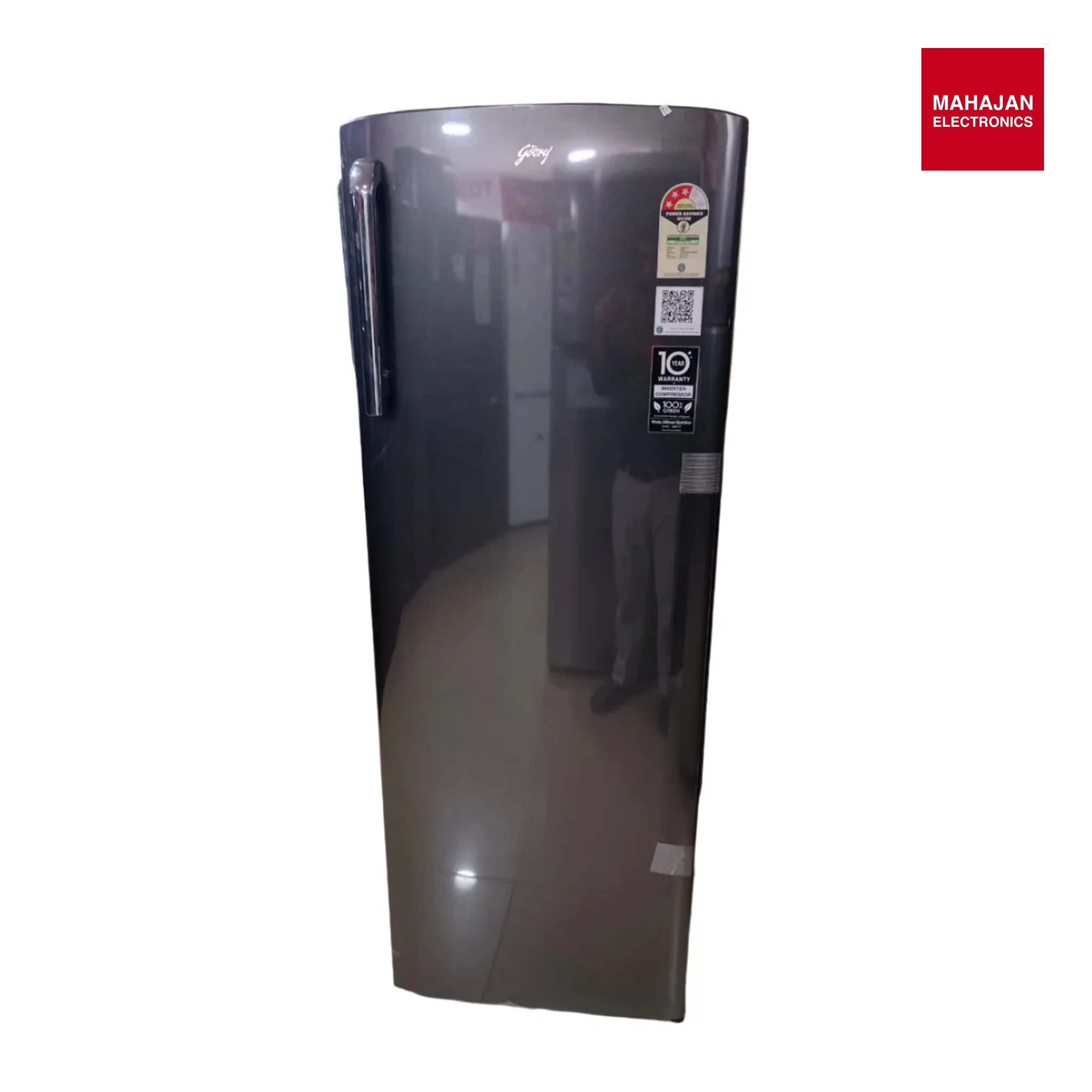
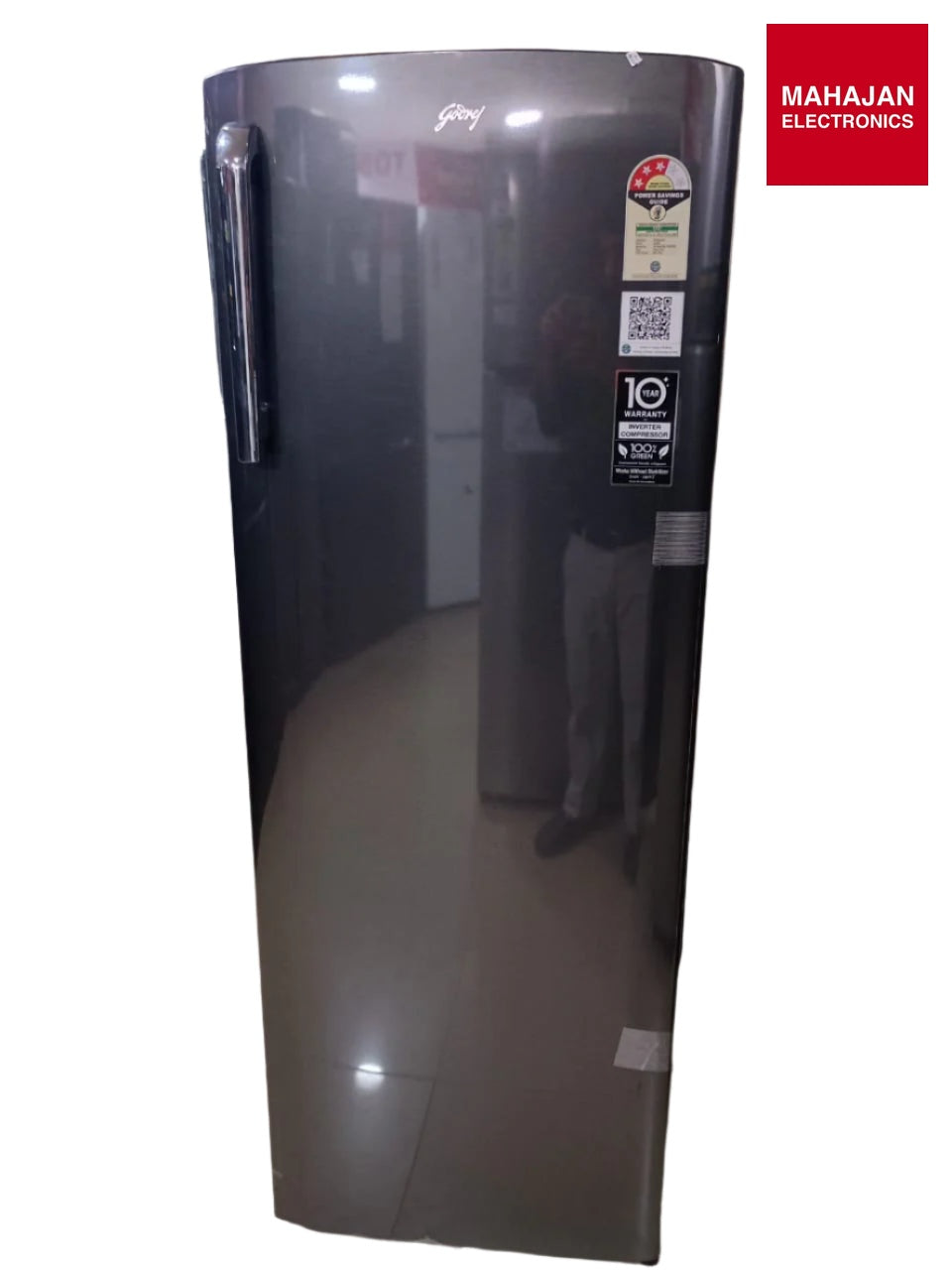
| Finish | Steel Glow ✅ |
| Door Orientation | Right-hand ✅ |
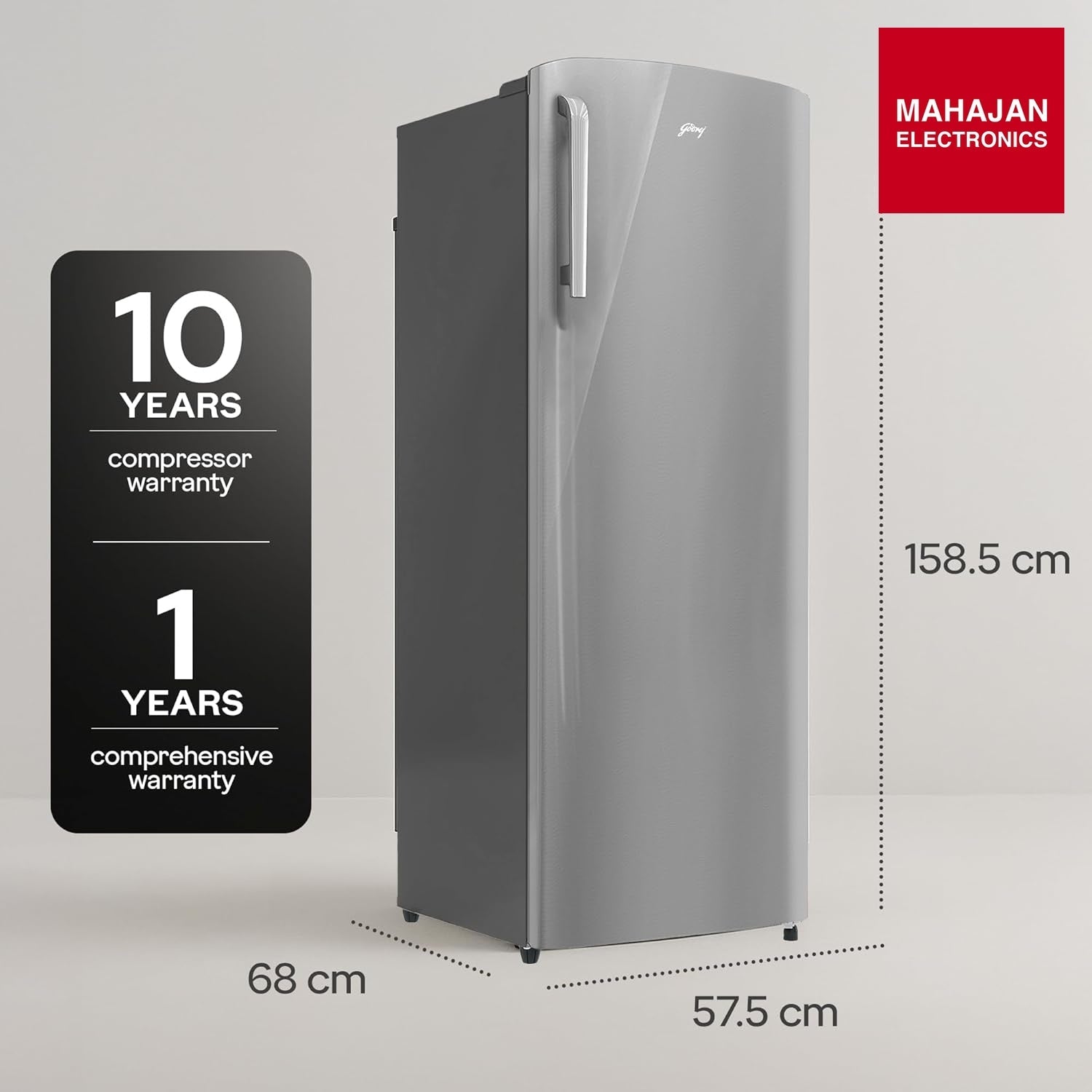
| Dimensions (D×W×H) | 68 × 57.5 × 158 cm ✅ |
| Weight | 44 kg ✅ |
| Voltage | 230 V ✅ |
| Country of Origin | India ✅ |
| Warranty | 1 year comprehensive + 10 years on compressor ✅ |
| Defrost Type | ⚠️ Stated as automatic, which is unusual for direct cool. Please have us confirm whether the freezer requires manual defrosting. |
| Turbo Cooling Figures | ⚠️ Faster-ice and quicker-bottle-cooling claims are stated without a comparison baseline. Ask us. |
| Crisper Freshness Claim | ⚠️ Manufacturer test conditions not stated; results vary with produce and usage. |
| Stabiliser Requirement | Not stated — important in Delhi NCR; ask us whether a stabiliser is recommended ⚠️ |
| Operating Voltage Range | Not stated in supplier material ⚠️ |
| Refrigerant | Not stated in supplier material ⚠️ |
| Noise Level | Not stated in supplier material ⚠️ |
| Installation & Delivery Charges | Not stated — confirm before ordering ⚠️ |
Why buy from Mahajan Electronics?
- Genuine Godrej — authorised partner
- We size the fridge to your household honestly
- GST invoice — save up to 18% on business purchases
- 24-hour delivery across Delhi NCR
- 45+ years of trust · rated 4.7 on Google
- Raja Garden · Jail Road · Dabri Mor
The compressor is the fridge. This one is covered for ten years.
Godrej EMARVEL 290CN THI FS ST · 268 Litre Direct Cool Single Door Refrigerator · Inverter Compressor · 3 Star BEE · 172 kWh/Year · Turbo Cooling · Farm Fresh Crisper With 16.4 L Jumbo Tray · Advanced Capillary Technology · 4 Toughened Glass Shelves · Large Bottle Shelf · 245 L Fresh + 23 L Freezer · 230 V · 68 × 57.5 × 158 cm · 44 kg · Steel Glow · Made In India · 1 Year Comprehensive + 10 Year Compressor Warranty
Warranty as per Godrej terms and conditions — 1 year comprehensive warranty on the product and 10 years on the compressor as stated in supplier material. The scope of cover, parts and labour, what the compressor warranty covers in years two to ten including whether labour and gas charging are included, exclusions, product registration and the service process are subject to brand policy and the final invoice or warranty card and should be confirmed before purchase. Damage arising from misuse, incorrect installation, operation without adequate ventilation clearance, unsuitable or unstabilised electrical supply, damage to the evaporator during defrosting or unauthorised servicing is commonly excluded. Supplier material describes this model as having automatic defrost, which is unusual for a direct cool single door refrigerator; the defrost arrangement, including whether the freezer compartment requires periodic manual defrosting, should be confirmed before purchase. Turbo Cooling performance claims regarding faster ice-making and bottle cooling are stated without a comparison baseline and should be confirmed. The Farm Fresh Crisper freshness claim is based on the manufacturer's own test conditions, which are not stated; actual results vary with produce type, initial freshness, storage temperature, load and how often the drawer is opened. Stabiliser requirement, operating voltage range, refrigerant type, noise level and any installation or delivery charges are not stated in supplier material and should be confirmed before purchase. Capacity, energy consumption of 172 kWh per year, BEE star rating, dimensions and weight are manufacturer specifications determined under standard test conditions; actual energy consumption varies with ambient temperature, door openings, load, thermostat setting, ventilation clearance and supply voltage, and the BEE rating year should be verified on the product energy label. Running cost depends on the applicable electricity tariff slab and usage and should be calculated against the purchaser's own tariff. Explanations of inverter compressor operation, direct cool convection, crisper humidity behaviour and capillary heat exchange provided here are general information to aid understanding and are not manufacturer specifications. This product is a household appliance and not a medical device; no health, nutritional or food-safety outcome is claimed or implied, and normal food hygiene and storage practice should be followed. The appliance weighs 44 kg and must be moved by two people, kept upright, and allowed to stand upright for several hours before being switched on if it has been tilted or transported lying down. It must be installed level on a firm floor with adequate ventilation clearance at the rear and above, connected to a properly earthed socket, and must not be connected through light-duty extension boards. Sharp implements must never be used to remove frost, as puncturing the evaporator releases refrigerant and renders the appliance unserviceable. Flammable or explosive substances must not be stored inside. The door seal should be kept clean and checked periodically. Children must not be permitted to hang on the door or enter the appliance, and doors should be removed before disposal of any old refrigerator. Discontinue use and disconnect the appliance if the cord or plug is damaged, if it trips the electrical supply, or if burning or gas odour is detected. Image for reference only; actual serial number, manufacturing date, packaging, shelves, trays, finish, colour tone and specifications may vary by batch or model revision.
Please Note: The image shown is for reference purposes only. Actual product details, including the serial number and manufacturing date, may vary.

