
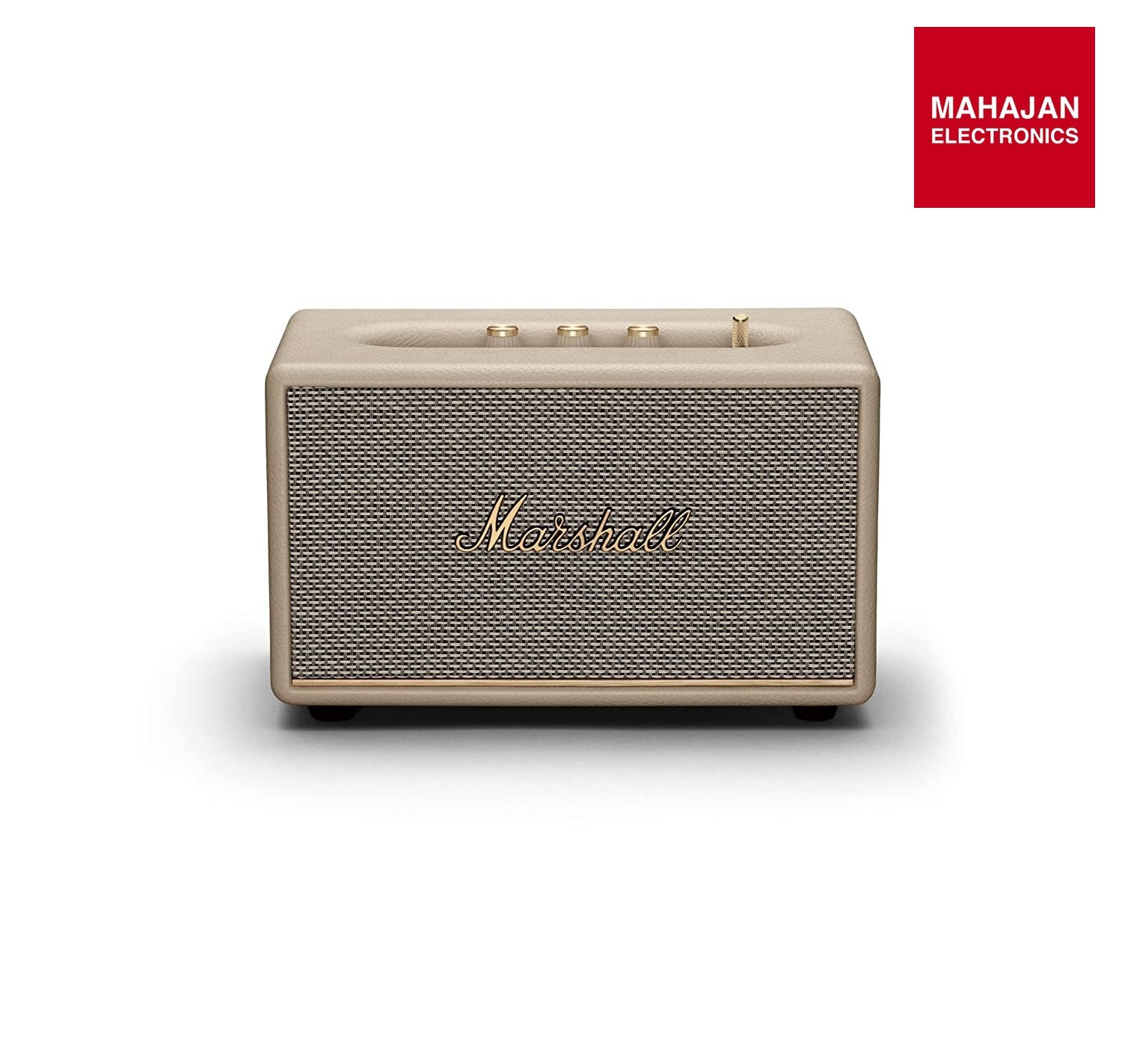
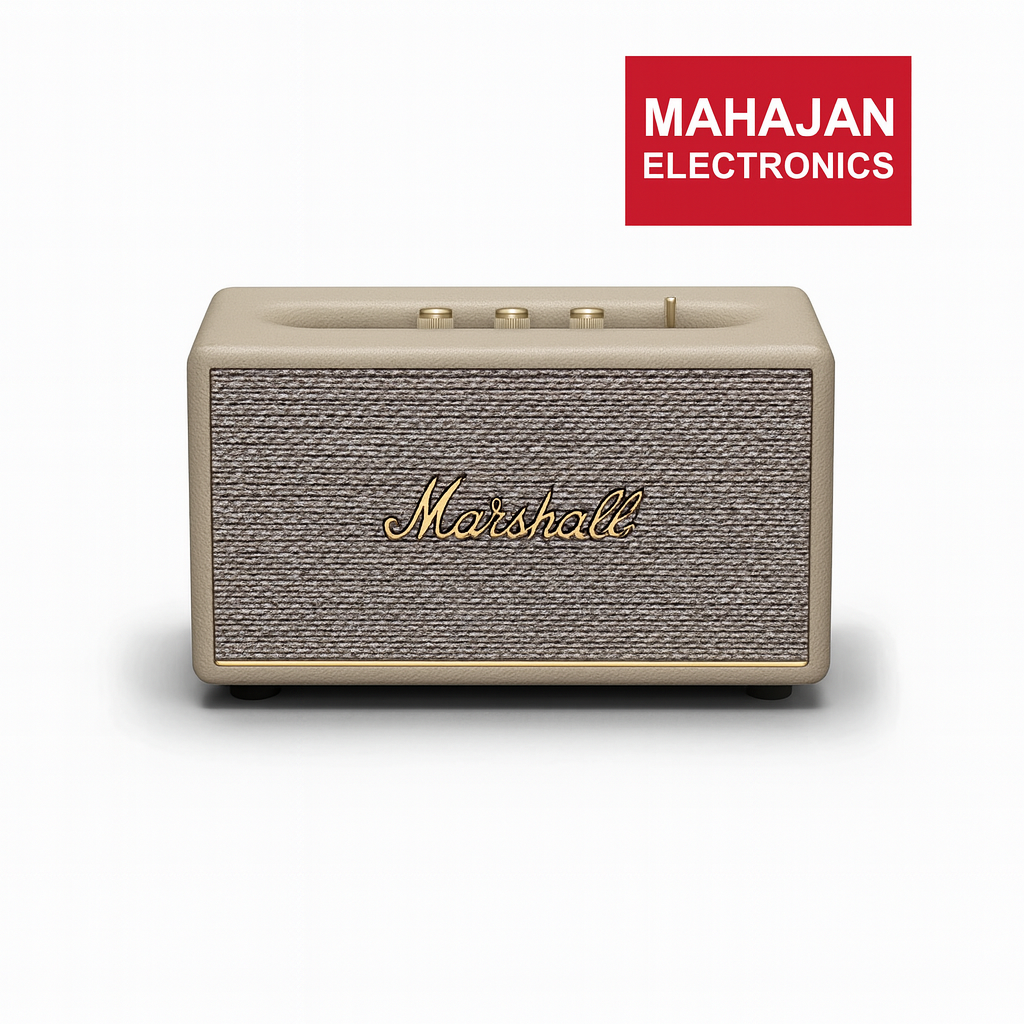
Marshall Acton III Bluetooth Speaker – Gen 3 with Wider Stereo Sound, Sustainable Design & Bluetooth 5.2 – Cream

Save 24%

Price:
Sale priceRs. 24,292.00 Regular priceRs. 31,999.00

Description

🛡️

✅ Marshall Standard Manufacturer Warranty — Authorised Marshall Partner · 100% Genuine · Mahajan Electronics Since 1981

Angled tweeters · Wider stereo soundstage · Dynamic Loudness · Placement Compensation · BT 5.2 · Aux-in · Analog controls · 70% recycled plastic · PVC-free · Vegan · 26×16.9×15cm · 2.85kg · Cream · Mains-powered.

🧾 GST Invoice Available — Save up to 18% on Business Purchases · Expert Audio Guidance · Call 9710000251
🚚 24-Hour Delivery — Delhi NCR 🌍 70% Recycled · PVC-Free · Vegan 🧾 GST Invoice — Save 18% Angled Tweeters · Wider Stereo · Dynamic Loudness · Placement Compensation · BT 5.2 · Aux · Analog Controls · 2.1ch · 26×16.9×15cm · 2.85kg · Cream
Marshall Acton III · Bluetooth 5.2 · 2.1 Channel · Tabletop Speaker · Cream · Generation III

Acton III. Wider stereo. Angled tweeters.
Dynamic Loudness. Placement Compensation. BT 5.2.
Analog controls. 70% recycled. PVC-free. Vegan. Cream.

The Marshall Acton III is the third generation of Marshall's iconic tabletop bookshelf speaker — re-engineered angled tweeters and enhanced waveguides produce a dramatically wider stereo soundstage than the Acton II; Dynamic Loudness maintains tonal balance at all volume levels; Placement Compensation corrects for acoustic interference from walls and surfaces; Bluetooth 5.2 with next-generation feature compatibility; analog controls for volume, bass, treble; 70% recycled plastic, PVC-free, vegan-friendly construction. Mains-powered. Cream finish.

Wider StereoAngled tweeters + enhanced waveguides
BT 5.2Next-gen Bluetooth — future compatible
2.1 ChannelStereo tweeters + bass driver
70% RecycledPVC-free · vegan materials
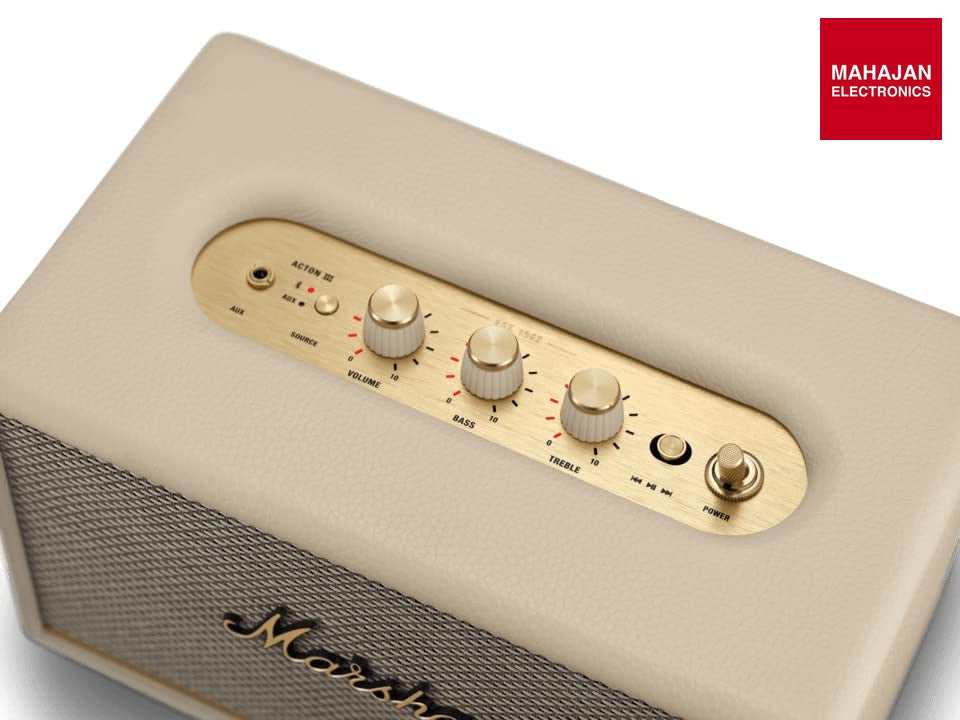
Analog DialsVol + bass + treble — no app needed
Placement CompCorrects wall/surface acoustic interference
2.1 channel speaker system — three drivers in one cabinet

🔊 Two angled tweeters + one woofer — what each driver does

Left Tweeter (Angled)

High-frequency left channel · angled outward · expands perceived left stereo edge beyond cabinet width

🔊

Woofer (Centre)

Bass / LFE channel (.1) · low-frequency energy · fills the room · non-directional below ~200Hz

Right Tweeter (Angled)

High-frequency right channel · angled outward · expands perceived right stereo edge beyond cabinet width


🔊

Angled tweeters + enhanced waveguides — the acoustic engineering behind "wider stereo"

Standard bookshelf speakers position their tweeter and woofer vertically centred on the cabinet's front baffle, with the tweeter's high-frequency output directed straight ahead along the speaker's primary axis. A standard speaker's stereo image is therefore constrained to the space between the two speakers and slightly beyond — the perceived left and right extent of the soundstage is determined by the physical separation of the two speaker cabinets and the listener's position relative to them. At typical living room placement distances (2–3.5 metres listening distance with speakers 1–1.5 metres apart), this creates a relatively narrow stereo image that occupies a limited central zone of the listening space. The Marshall Acton III — being a single cabinet 2.1 channel speaker rather than a stereo pair — faces the additional challenge of creating convincing stereo separation from a single enclosure. The angled tweeter design addresses this by physically rotating each tweeter outward from the forward-facing axis — the left tweeter is angled to emit high-frequency energy toward the left side of the room and the right tweeter toward the right, effectively spreading the stereo information across a wider arc than the cabinet's physical width. The enhanced waveguide — a specifically shaped acoustic lens positioned in front of each tweeter — further controls the directivity and dispersion pattern of the high-frequency output, ensuring that the angled energy is spread evenly across a wide horizontal arc rather than narrowly beaming in a single direction. The perceptual result is that high-frequency content (which carries the primary stereo localisation cues — the harmonic overtones of instruments, vocal sibilance, percussion attacks) appears to originate from points outside and beyond the physical cabinet boundaries, creating the impression of a wider soundstage than the speaker's 26cm cabinet width would normally suggest.

🎚️

Dynamic Loudness + Placement Compensation — two automatic adjustments that keep the Acton III sounding its best

Dynamic Loudness addresses the ISO 226 equal-loudness phenomenon (the same perceptual issue addressed by the Marshall Monitor III ANC headphone's Dynamic Loudness Technology): at low listening volumes, the human ear is significantly less sensitive to bass frequencies (below 200Hz) and high frequencies (above 8kHz) relative to the midrange. Without compensation, reducing volume makes music sound thin — bass disappears and the top-end sparkle dulls — as the ear's sensitivity curve changes with SPL. Dynamic Loudness applies an automatic frequency response adjustment that increases bass and treble gain relative to midrange as volume decreases, maintaining the perceptual tonal balance that the recording engineer intended across the Acton III's full volume range from whisper-quiet to full output. Placement Compensation addresses a different acoustic problem: bass frequencies are strongly affected by room boundaries. A speaker placed near a wall or in a room corner receives acoustic reinforcement from wall reflections — the bass frequencies from the woofer radiate in all directions, hit the nearby wall, reflect back, and add to the direct output, increasing perceived bass level by up to 6dB (a doubling of perceived bass loudness). Without compensation, a speaker designed to produce flat bass response in free space produces excessively boomy, one-note bass when placed near a wall — a common placement scenario in Indian homes where furniture is typically arranged against walls. Placement Compensation applies a high-pass filter or bass shelf reduction to the woofer's output when wall proximity is detected or manually selected, reducing the bass output to account for the expected wall-reinforcement boost — the combined result of reduced direct bass + reflected reinforced bass equals the flat bass response that sounds natural and articulate rather than boomy.

📶

Bluetooth 5.2 + analog controls — why both matter, and what "next-gen feature compatibility" means

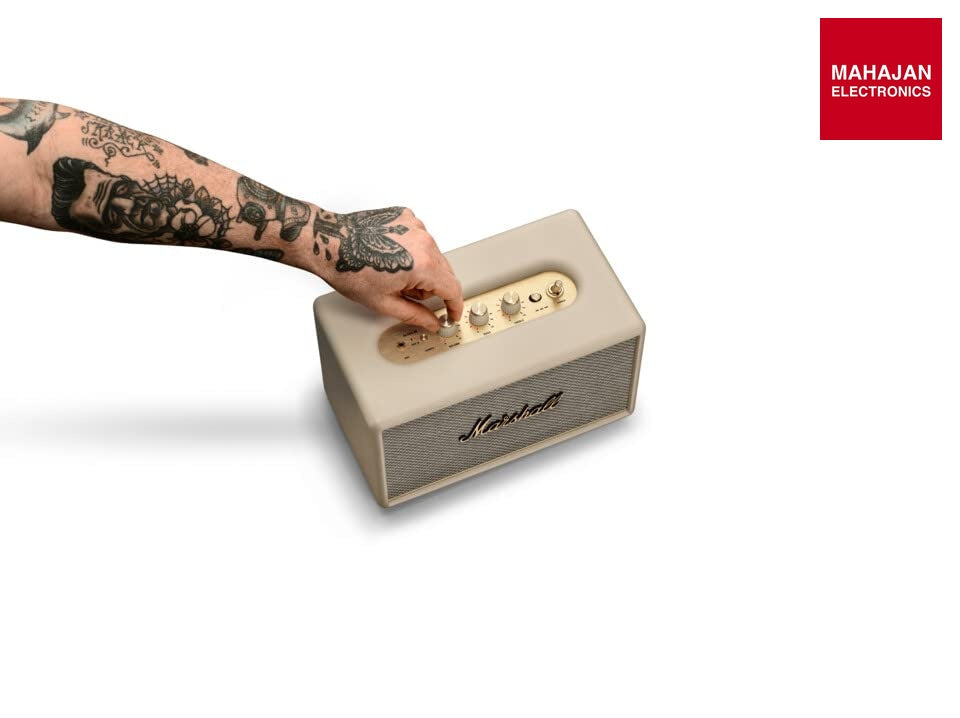
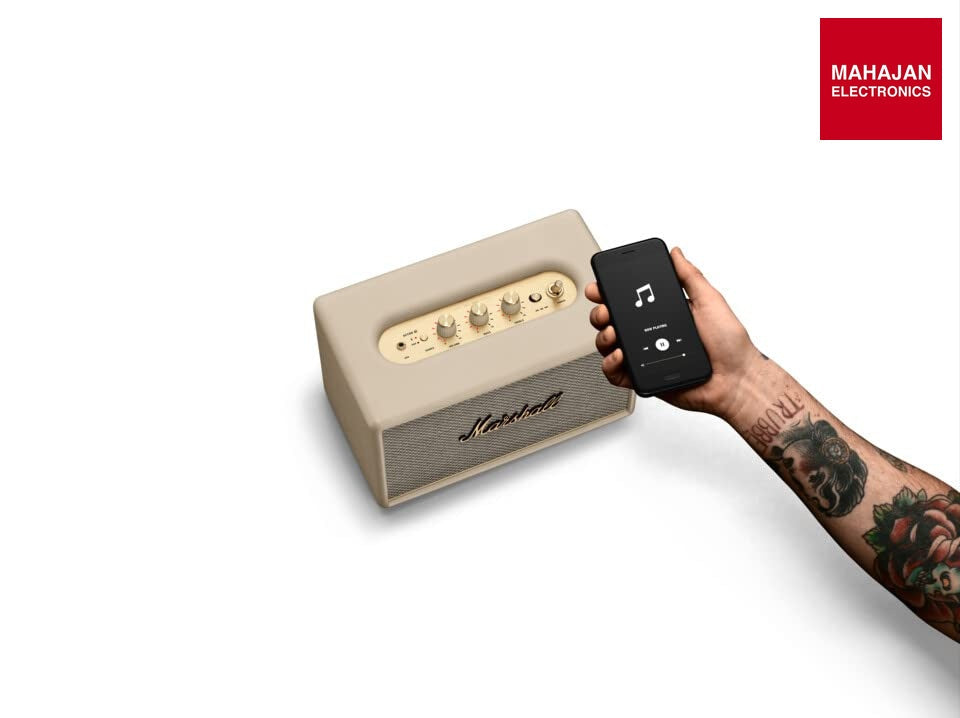
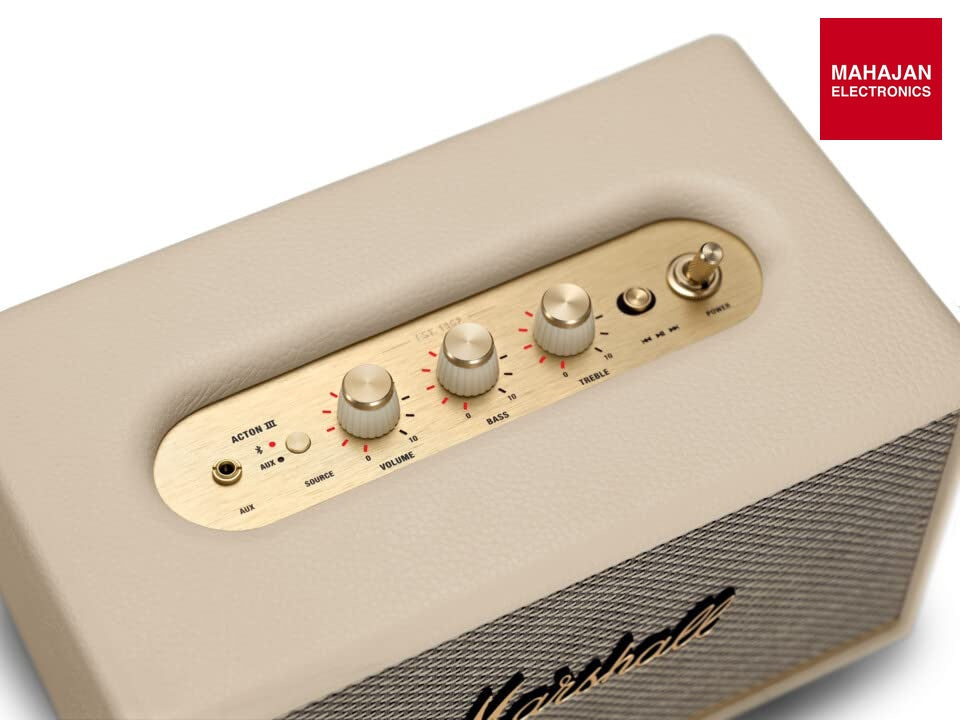
Bluetooth 5.2 introduced several protocol-level improvements over Bluetooth 5.0/5.1 relevant to audio applications. The most significant for speaker users is Enhanced Attribute Protocol (EATT), which allows multiple simultaneous Bluetooth attribute operations — enabling faster connection establishment and more stable connections in dense wireless environments (apartments in Delhi NCR where 10–30 Bluetooth devices from adjacent flats may share the 2.4GHz band). Bluetooth 5.2 also introduced LE Audio, the architectural foundation for the next generation of Bluetooth audio: LE Audio supports LC3 (Low Complexity Communication Codec), which at equivalent bit rates to SBC produces significantly better audio quality, and at lower bit rates produces comparable quality — enabling more efficient audio streaming that preserves battery life on the source device. LE Audio also introduces Auracast broadcast audio (which JURA's Heston 120 soundbar and Samsung's Sound Tower MX-ST40F also support at Mahajan Electronics). The Acton III's "next-gen Bluetooth features" language reflects that these LE Audio capabilities become available through the BT 5.2 hardware platform as software and ecosystem support matures. The analog controls (volume dial, bass dial, treble dial, Bluetooth pairing button, power switch) reflect Marshall's design philosophy that fundamental audio adjustments should be physically accessible without navigating an app — the dials provide direct, tactile, immediate control of the speaker's core parameters. Bass and treble adjustment via dedicated dials is particularly useful for the Acton III's role as a room-filling home speaker where the acoustic character of different rooms may require different EQ to sound natural.

🌍

70% recycled plastic + PVC-free + vegan — what Marshall's sustainability commitments mean materially

Marshall's Acton III sustainability claims — 70% recycled plastic, PVC-free construction, and vegan-friendly materials — each represent specific material choices in the speaker's construction. 70% recycled plastic means that 70% of the plastic content in the cabinet and housing components is sourced from post-consumer or post-industrial recycled plastic feedstock rather than virgin petroleum-derived plastic. The acoustic properties of recycled plastic are comparable to virgin plastic for speaker cabinet applications (where rigidity and low resonance are the primary material requirements rather than optical clarity or surface finish), making recycled plastic a viable material substitution without acoustic compromise. PVC (polyvinyl chloride) has historically been used in cable insulation, tolex-style cabinet covering, and speaker grille materials. PVC manufacturing involves chlorine chemistry that produces dioxin by-products; PVC disposal (particularly incineration) also releases dioxin and hydrochloric acid. PVC-free construction eliminates these concerns across the product's manufacturing and end-of-life phases. Vegan-friendly materials specification addresses the use of animal-derived materials in speaker components — particularly the woven fabric used in Marshall's signature speaker grille material, which in traditional speaker construction may be wool-content fabric. The vegan specification confirms that the Acton III's grille fabric, adhesives, and all other components are manufactured without animal-derived inputs. For buyers who prioritise environmental and ethical supply chain credentials alongside audio performance, the Acton III's stated material commitments represent concrete product decisions rather than marketing language — though independent verification of exact recycled content percentages rests with Marshall's supply chain documentation.


🌍 Sustainability — what each commitment means

♻️

70% Recycled Plastic

Post-consumer/post-industrial recycled feedstock — same acoustic performance as virgin plastic

🚫

PVC-Free

No polyvinyl chloride in cables, cabinet covering, or grille — eliminates dioxin production concern

🌱

Vegan Materials

No animal-derived inputs in grille fabric, adhesives, or any component — confirmed by Marshall

🔗 Connectivity + Controls

📶

Bluetooth 5.2

Next-gen BT — stable in dense environments, LE Audio ready

🔌

3.5mm Aux-In

Wired input — any device, zero latency, zero pairing

🎛️

Analog Dials

Volume · Bass · Treble — physical knobs, no app required

📦 What's in the Box

🎵 Acton III Speaker 🔌 Mains Lead (corded electric — not battery) 📖 User Manual ⚠️ Safety Information

🎯 Ideal for

Home listening — bookshelf / tabletop stereo
Premium interior design — Cream statement piece
Wall-adjacent placement — Placement Compensation
Eco-conscious buyers — 70% recycled, vegan
Audiophiles who prefer analog controls
Premium gifting — iconic Marshall design
Technical specifications
Brand Marshall (by Zound Industries)
Model Acton III
Generation Third Generation (III)
Type Tabletop / Bookshelf Home Speaker
Channel configuration 2.1 (Stereo tweeters × 2 + Woofer × 1)
Tweeter design Angled — expanded stereo dispersion
Waveguide Enhanced — controls high-frequency dispersion pattern
Dynamic Loudness Yes — auto tonal balance at all volume levels
Placement Compensation Yes — corrects wall/corner bass reinforcement
Bluetooth 5.2 — LE Audio ready, future feature compatible
Additional input 3.5mm Aux-In
Controls Analog dials — Volume, Bass, Treble + BT pairing + Power
⚠️ Power source Mains-powered (corded electric) — Mains Lead in box. Listing spec states "battery" but this is an error. Acton III has no built-in rechargeable battery.
Materials 70% recycled plastic · PVC-free · Vegan-friendly
Colour Cream
Dimensions (W×H×D) 26 × 16.9 × 15 cm
Weight 2.85 kg
Origin China (Marshall / Zound Industries)


Warranty Marshall Standard Manufacturer Warranty — verify duration at purchase

🛡️ Marshall Manufacturer Warranty + Authorised Partner

Marshall Manufacturer Warranty Verify duration at purchase
100% Genuine Marshall Authorised partner
Cream Iconic Finish Made in China · Zound Ind.
Why buy from Mahajan Electronics
100% genuine Marshall — authorised partner
Expert audio guidance + in-store demo
24-hour delivery across Delhi NCR
GST Invoice — save up to 18%
45+ years trusted retail since 1981
mahajanelectronics.com · Raja Garden · Jail Road · Dabri Mod

Wider Stereo. Angled Tweeters. Dynamic Loudness. Placement Compensation. BT 5.2. Analog Controls. 70% Recycled. PVC-Free. Vegan. Cream. Order today.

Marshall's iconic tabletop speaker — third generation, wider soundstage, smarter acoustic correction, more sustainable construction. Mains-powered. 24-hour delivery Delhi NCR. GST invoice. Genuine Marshall since 1981.

📍 Raja Garden 📍 Jail Road 📍 Dabri Mod 📞 9710000251 🌐 mahajanelectronics.com

⚠️ Power: Acton III is mains-powered — listing spec stating "rechargeable battery" is an error (mains lead is in box; no battery). Verify at purchase if portability is required. ⚠️ Voltage: not stated — verify 220–240V 50Hz India compatibility. Warranty duration: verify at purchase. 70% recycled plastic, PVC-free, vegan claims per Marshall specification — independent verification at purchase recommended. Product image for reference.


Shop the Marshall Acton III (Cream) today at Mahajan Electronics and bring home a sound experience that’s as iconic as your taste.

Made in China

You may also like

Recently viewed