





Description
✅ Marshall Brand Warranty — Authorised Marshall Partner · 100% Genuine · Mahajan Electronics Since 1981
70-Hr ANC ON / 100-Hr ANC OFF battery. Adaptive ANC + Transparency. Soundstage Spatial Audio. Dynamic Loudness. BT 5.0 + 3.5mm. Touch controls. Hard-shell case included.
70 hours ANC ON. 100 hours ANC OFF.
Adaptive ANC. Soundstage Spatial Audio. Dynamic Loudness Technology.
BT 5.0 + 3.5mm. Touch controls. Foldable. Hard-shell case. Unmistakably Marshall.
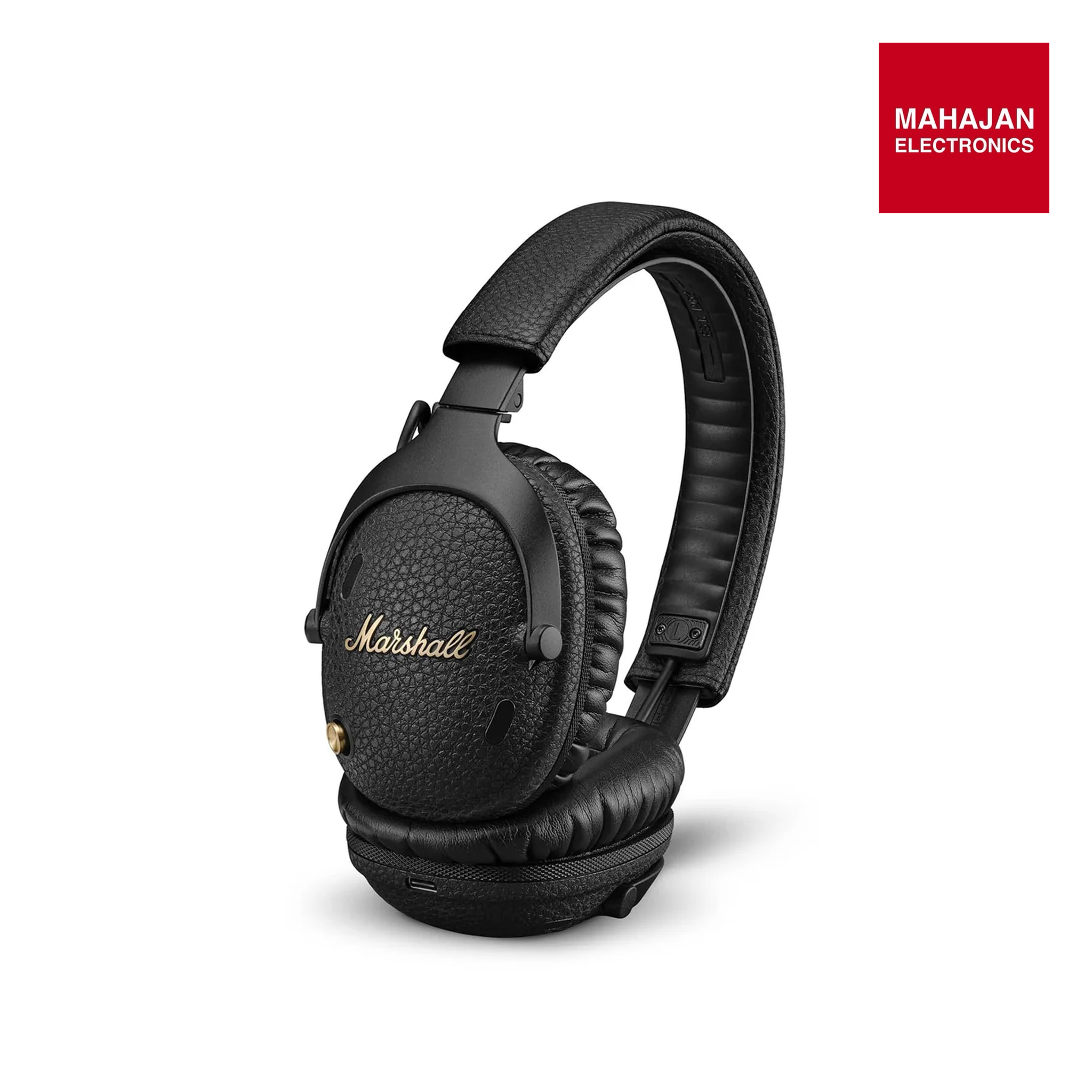
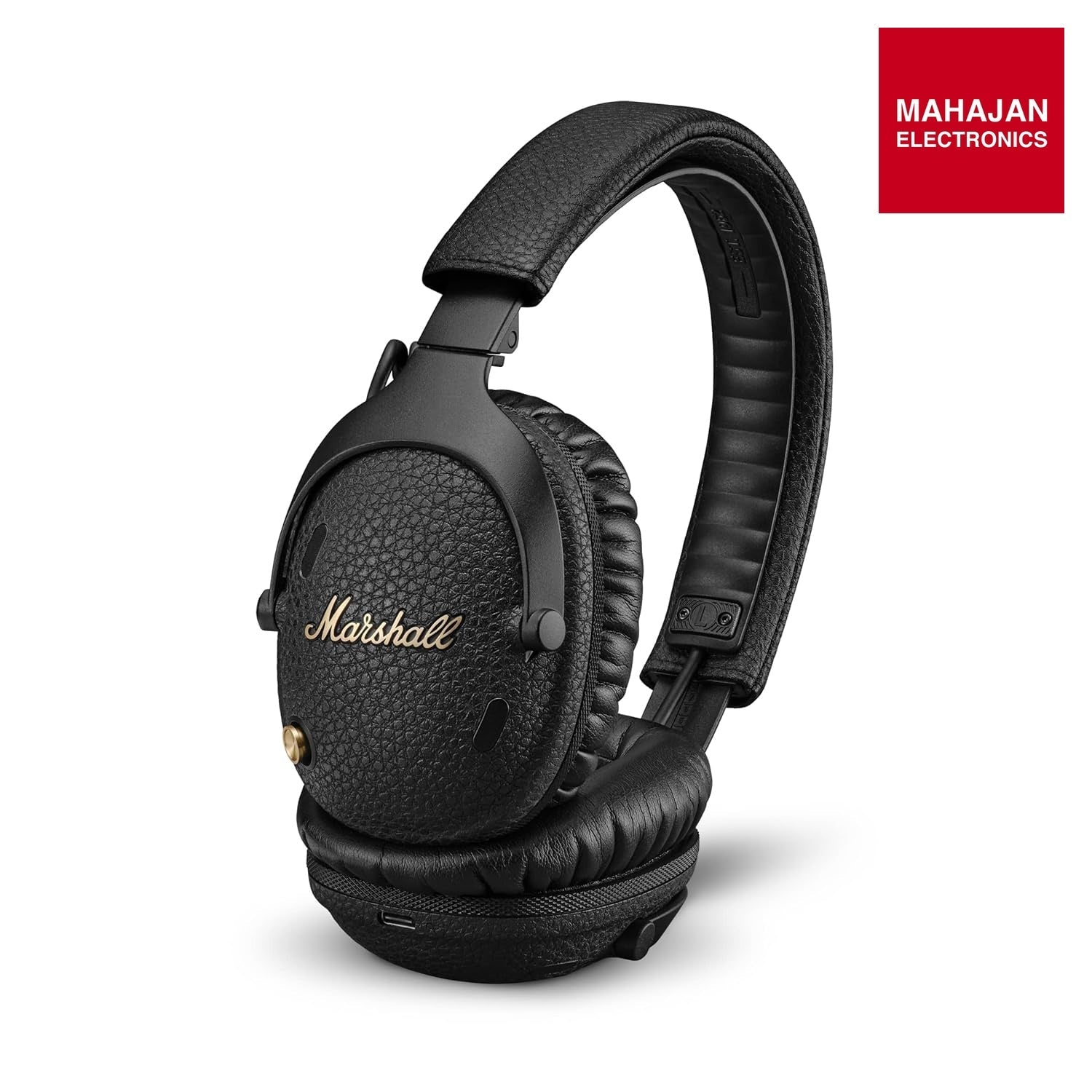
The Marshall Monitor III ANC is the definitive over-ear headphone for listeners who demand legendary sound quality and class-leading battery life. Adaptive ANC continuously measures and adjusts cancellation in real time; Marshall Soundstage Spatial Audio expands the soundstage beyond your head for a live-concert experience; Dynamic Loudness Technology maintains tonal balance from whisper-quiet to full volume. 70 hours ANC ON — the longest battery in its class. Iconic Marshall black finish. Rock heritage design.
🔋 Days of listening without reaching for a charger
🔇 With ANC Active
Full noise cancellation ON — 3 full work weeks of commuting, 4+ long-haul flights, 10 full music days
🎵 ANC Off / Passive
Passive listening or transparency mode — over 4 days continuous, extended travel, studio monitoring
🔇 Adaptive ANC + Transparency Mode — two sides of noise control
Adaptive Active Noise Cancellation
- Continuously measures surrounding noise via external microphones
- Dynamically adjusts cancellation depth in real time
- Adapts to changing environments — office, commute, aircraft
- Does not degrade sound quality when ANC is active
- Feels like being alone in the room with your music
- 70 hours with ANC active — no compromise on runtime
Transparency Mode
- Hear ambient sound without removing headphones
- Airport announcements, train stops, conversations
- Stay alert outdoors — traffic, voices around you
- Toggle instantly via touch control gesture
- Music continues playing beneath ambient awareness
- No need to remove headphones to interact
Adaptive ANC — why "adaptive" matters more than just having ANC
Active Noise Cancellation (ANC) works through a feed-forward and/or feedback microphone system that captures ambient noise and generates an inverse phase (anti-noise) signal that destructively interferes with the noise before it reaches the ear canal. Basic ANC systems apply a fixed cancellation profile — a pre-set frequency-response curve that has been optimised for the most common noise environments (typically aircraft cabin noise, around 300–500 Hz where jet engines produce the highest SPL). This fixed-profile approach works well in the specific environment it was tuned for but underperforms in environments with different noise characteristics: office HVAC (which peaks at different frequencies than aircraft), traffic noise (broadband with strong low-frequency components from diesel engines), or railway carriages (rhythmic clatter with strong impulse components). Adaptive ANC — as implemented in the Marshall Monitor III — uses the feed-forward microphones to continuously sample the ambient noise in real time and calculate an optimal cancellation profile for the current acoustic environment, updating this profile dynamically as conditions change. The practical experience: stepping from a noisy street into a quiet office, or from a Metro carriage to an open platform, the Monitor III's cancellation response adjusts to the new noise profile within milliseconds rather than applying the same cancellation depth that was appropriate for the Metro (which would over-cancel in the quieter office, creating an unnaturally dead acoustic sensation). The continuous measurement also allows the adaptive system to handle intermittent noise events (a car horn, a door slamming) more effectively than fixed-profile systems, which either over-cancel quiet periods or under-cancel loud events. For the Marshall Monitor III's target users — commuters, office workers, frequent travellers — adaptive ANC provides consistently effective noise reduction across the full range of daily acoustic environments encountered rather than only in the one environment the headphone was specifically tuned for.
Marshall Soundstage Spatial Audio — what spatial processing achieves in over-ear headphones
Conventional headphone listening has a characteristic perceptual property: the sound appears to originate inside the head — specifically, stereo imaging in standard headphones creates a left-right sense of width that is localized to a point somewhere between the ears within the skull. This "in-head localisation" is the reason headphone listening, even with excellent stereo separation, feels different from listening to loudspeakers in a room: speakers produce sound that travels outward from their positions, interacts with room reflections, and reaches each ear with the inter-aural timing and spectral differences that the auditory system uses to perceive a sound as coming from external space. Marshall Soundstage Spatial Audio uses head-related transfer function (HRTF) processing to simulate the acoustic cues that position sound in external space. HRTF captures the characteristic changes that sound undergoes as it interacts with the outer ear (pinna), head, and torso before reaching the ear canal — these interactions create specific frequency response changes and inter-aural timing delays that the auditory cortex has learned to associate with specific spatial positions. By processing the audio signal with HRTF parameters, the Monitor III creates the psychoacoustic impression that sound sources are located at positions outside the head — instruments appear to be positioned in front and to the sides of the listener, percussion tracks feel like they are placed in physical space around the listener, and reverb tails appear to extend outward into a virtual room rather than decaying inside the skull. The "live concert" description in Marshall's marketing reflects the primary intended effect: for music that was recorded or mixed with spatial intent (jazz performances, orchestral recordings, live concert recordings), the Soundstage processing creates the perception of being in the venue rather than in the recording. For Bollywood soundtracks and film scores with reverberant production, the expansion effect enhances the cinematic quality of the mix.
Dynamic Loudness Technology — why volume level changes how music sounds and how Marshall fixes it
The human auditory system has a well-documented non-linearity in its frequency sensitivity: at low listening levels, the ear is much less sensitive to bass and high-frequency content than it is to midrange frequencies (centred approximately at 1–4 kHz where speech intelligibility is concentrated). This perceptual phenomenon is described by the ISO 226 equal-loudness contours (formerly known as the Fletcher-Munson curves) — at low volume (30–40 dB SPL), a 100 Hz bass tone needs to be approximately 15–20 dB louder than a 1 kHz tone to be perceived as equally loud. The practical consequence for headphone listening: music that sounds balanced at high volume (where the ear's bass and treble sensitivity approaches its midrange sensitivity) sounds thin, bass-light, and dull when the same signal is played at low volume without compensation — this is why "turning down the volume" often makes music feel less engaging and less full. Dynamic Loudness Technology is Marshall's real-time compensation for this perceptual phenomenon — as the user reduces volume, the Monitor III's DSP processor adjusts the headphone's frequency response to boost bass and (to a lesser extent) treble relative to the midrange, compensating for the ear's reduced sensitivity at lower SPL. The result is that music sounds perceptually balanced regardless of the listening level: bass remains full and present at 30% volume; the sound at 20% volume retains the warmth and energy of the higher-volume presentation rather than becoming thin and midrange-dominated. For a use case where the user needs to reduce volume during a commute without losing music enjoyment (so as not to disturb others), or uses low volume during late-night listening sessions at home, Dynamic Loudness maintains the intended musical balance that the recording engineer created.
70 hours ANC ON — how Marshall achieves this and why it matters practically
Most premium ANC headphones in the ₹20,000–₹40,000 segment deliver 25–35 hours of ANC-active battery life — Sony WH-1000XM5 (30 hours), Bose QuietComfort 45 (24 hours), Apple AirPods Max (20 hours with ANC). The Marshall Monitor III's 70-hour ANC-on battery life is approximately 2–2.5× these competitors, which translates into meaningfully different real-world usage patterns. A user who commutes 2 hours daily (1 hour each way) with ANC active would charge a 30-hour ANC headphone approximately twice per week; the Monitor III would require charging approximately once per fortnight for the same usage pattern. For frequent travellers, 70 hours ANC-on covers a Mumbai-London-New York trip (approximately 28 hours of flight time) twice over on a single charge. The engineering approaches that enable extended ANC battery life typically include: more efficient ANC processor silicon (newer generation chips with lower static power consumption); higher-capacity battery cells; or optimised ANC algorithms that require fewer processor cycles per unit time. The 100-hour ANC-off battery provides the additional context that the Monitor III's underlying driver and amplifier efficiency is very high — the additional power consumed by the ANC processor accounts for approximately 30 hours (100 minus 70) of the battery budget. The 3.5mm wired connection option allows zero-battery, zero-Bluetooth, zero-latency playback as an ultimate backup for critical listening sessions where battery charge has depleted or where the listener prefers the direct electrical connection of a wired signal path.
✨ What makes Monitor III stand out — six headline features
70-Hr ANC Battery
~2.5× category average. Once-a-fortnight charging for daily commuters.
Adaptive ANC
Real-time environment analysis — adjusts per office, commute, flight.
Soundstage Spatial
HRTF processing — sound outside head, not inside skull.
Dynamic Loudness
ISO 226 compensation — full sound at every volume level.
BT 5.0 + 3.5mm
Wired fallback for zero-latency, zero-battery listening.
Hard-Shell Case
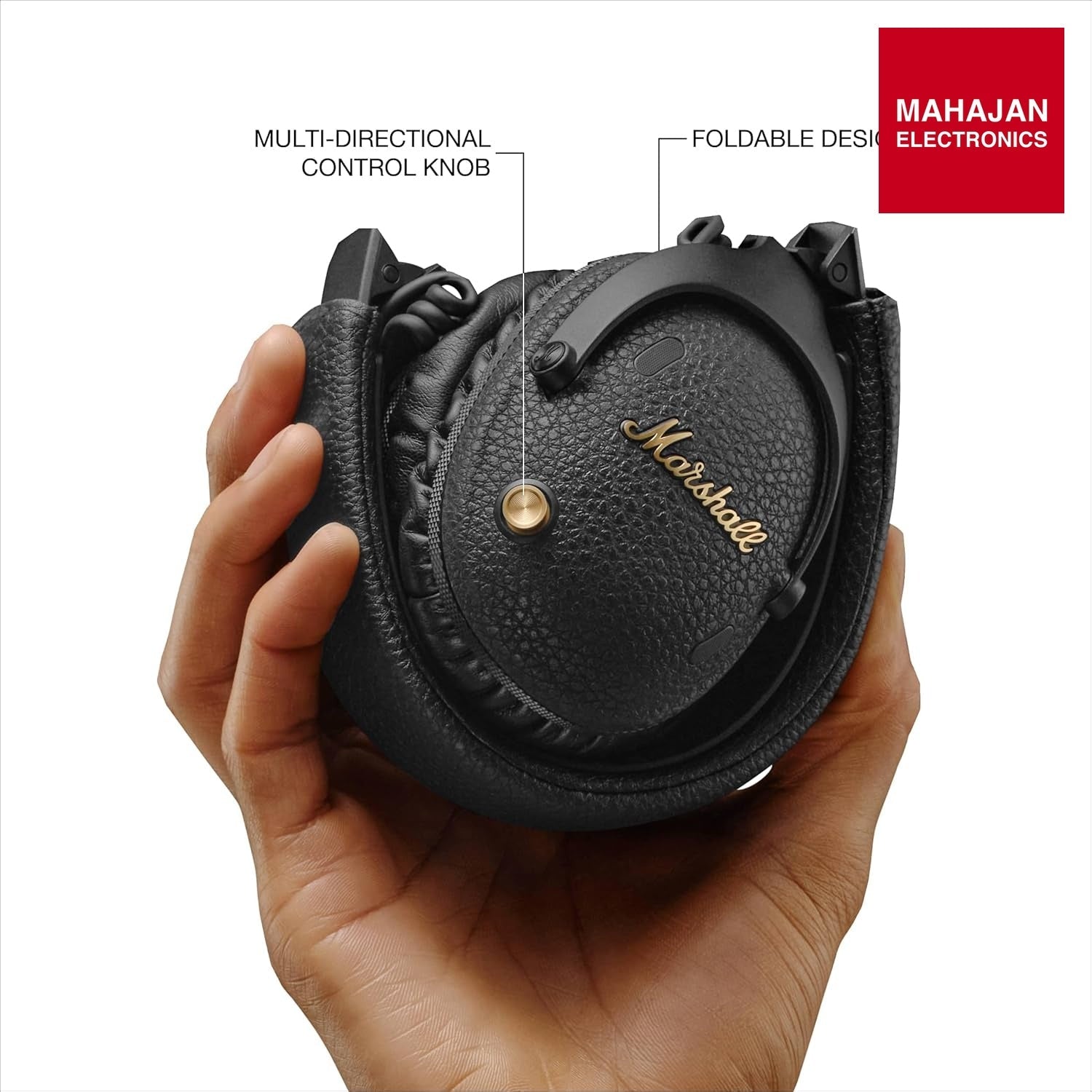
Foldable + hard case — travel-ready. 250g lightweight.
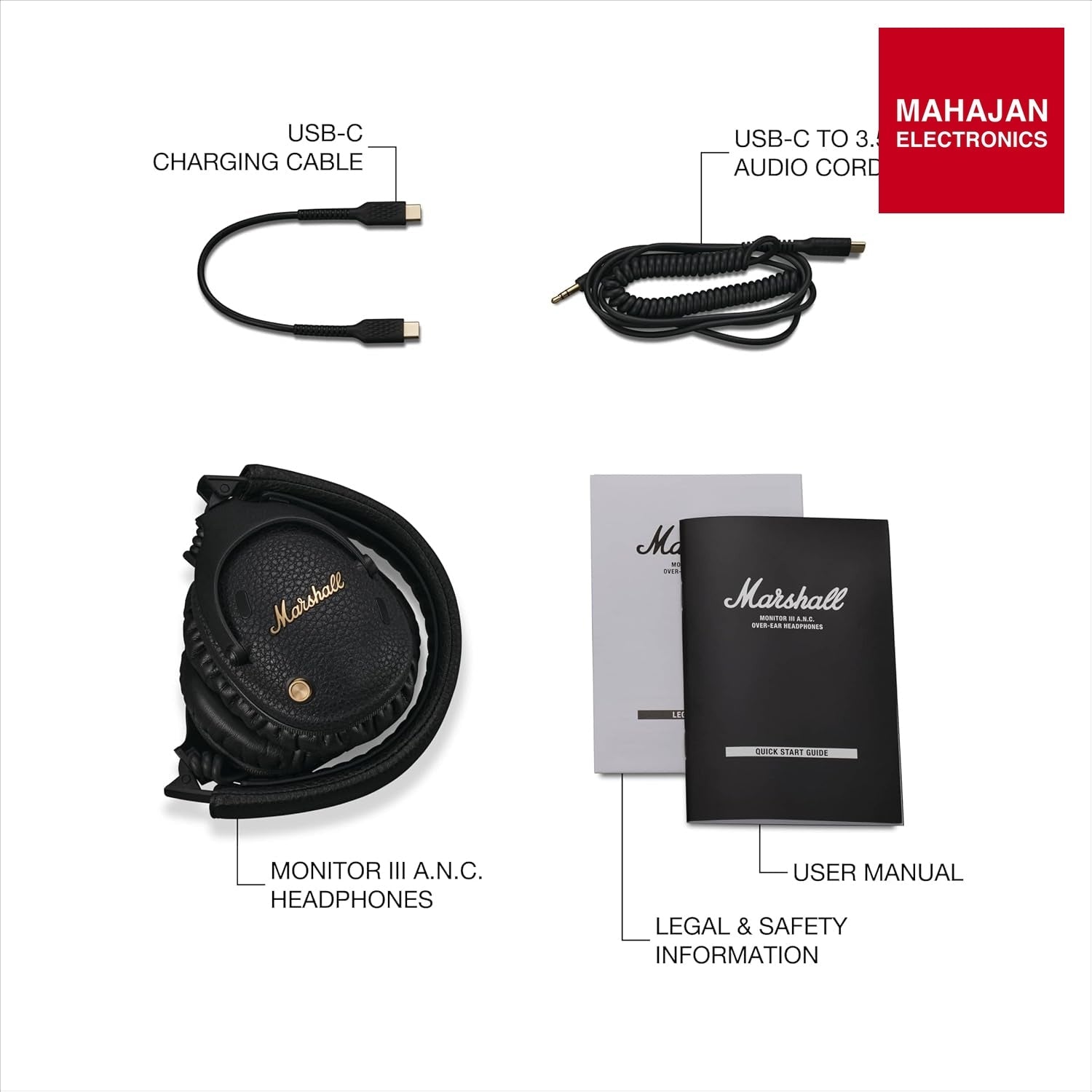
📦 What's in the Box
🎯 Ideal for
| Brand | Marshall |
| Model | Monitor III ANC |
| Type | Over-Ear Bluetooth ANC Headphones |
| ANC | Adaptive Active Noise Cancellation — continuously measures + real-time adjusts |
| Transparency mode | Yes — ambient awareness without removal |
| Spatial audio | Marshall Soundstage Spatial Audio — HRTF-based external sound projection |
| Loudness | Dynamic Loudness Technology — tonal balance at every volume level |
| Battery — ANC ON | Up to 70 Hours |
| Battery — ANC OFF | Up to 100 Hours |
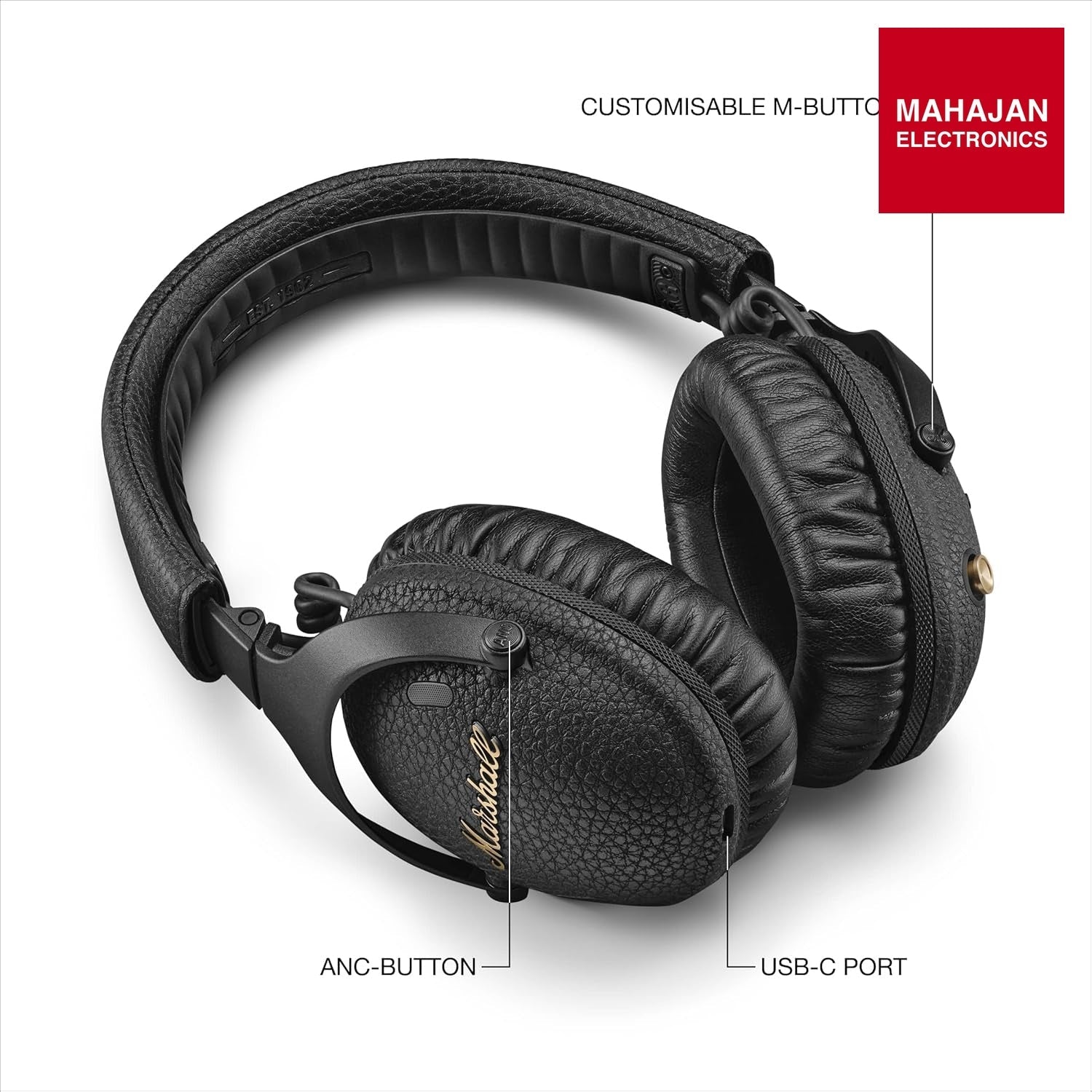
| Connectivity | Bluetooth 5.0 + 3.5mm audio jack (wired) |
| Range | Up to 10 metres (Bluetooth) |
| Controls | Touch Controls — play/pause, volume, skip, ANC/transparency toggle, calls |
| Microphone | Yes — built-in for calls |
| Drivers | Dynamic Drivers |
| Frequency response | 20 Hz – 20,000 Hz |
| Sensitivity | 117 dB |
| Impedance | 35 Ohms |
| Weight | Approx. 250g |
| Foldable | Yes — metal-reinforced hinges |
| Water resistance | Yes — rating not specified; protect from heavy rain/submersion |
| Colour | Black (Marshall signature finish) |
| In the box | Headphones · Hard-Shell Case · Charging Cable · 3.5mm Cable · Manual · Warranty Card |
| Warranty | Marshall Brand Warranty — verify duration at purchase |
🛡️ Marshall Brand Warranty + Authorised Partner
70-Hr ANC. 100-Hr Passive. Adaptive ANC. Soundstage Spatial. Dynamic Loudness. BT 5.0 + 3.5mm. Touch. Foldable. Hard Case. Unmistakably Marshall. Order today.
Class-leading battery. Legendary sound. Adaptive noise cancellation that adjusts to your world. 24-hour delivery Delhi NCR. GST invoice. Genuine Marshall — Mahajan Electronics since 1981.
Warranty duration — verify at purchase. 70-hour ANC / 100-hour passive battery at moderate volume — actual life varies with volume level and usage pattern. Water resistance: specific IP rating not confirmed in source — protect from heavy rain and submersion. Soundstage Spatial Audio effectiveness varies by recording and listener anatomy. ANC performance varies by ambient noise frequency and SPL. Product image for reference.


